
Uncategorized
Birko Hot Water Urn Spare Parts | Ring Hot Water

May
The urn was working yesterday. This morning it's cold, dripping, or tripping the circuit, and now the office kitchen, café bench, or service area has stalled with it.
That's usually when people start searching for birko hot water urn spare parts and hit the same problem. Parts are listed everywhere, but very few pages help you confirm which part fits your urn. A thermostat that looks right might be wrong for the model. A tap might mount differently. A sight glass might suit one capacity and not another. That's where time gets wasted.
Your Essential Guide to Birko Urn Parts
A Birko urn that has stopped heating, started leaking, or begun tripping power usually comes down to a serviceable part. The delay is rarely the repair itself. It is working out which exact part suits the urn on the bench before money is spent on the wrong tap, thermostat, element, or seal.
That identification step matters because Birko parts are not interchangeable across every urn in the range. Capacity affects fit. Mounting style affects whether a tap or sight glass will seat properly. Electrical rating affects whether a thermostat or element is even safe to install. A quick visual match from an online thumbnail is how incorrect orders happen.
The practical method is straightforward. Check the model plate if it is still legible. Confirm the urn capacity. Then match the fault to the part system involved: dispensing, heating, or body. From there, compare the mounting points, terminal layout, thread style, and overall dimensions before ordering.
If you still need to pin down which type of unit you are working on, this Birko hot water urn overview will help you sort the common models before you start sourcing parts.
Practical rule: Never order a Birko part on appearance alone if the urn capacity, mounting style, or electrical rating is not confirmed.
This guide is built to do more than list spare parts. It helps you identify the right one for your specific urn and decide whether the repair is worth doing. On older or lower-value units, a failed element plus heat damage to wiring or controls can push the job past sensible repair cost. On the other hand, a leaking tap, sight glass seal, or thermostat fault is often a straightforward fix that gets the urn back into service fast.
Visual Part Identifier An Exploded Urn View
When someone says, “the urn's leaking,” that still leaves several different faults on the table. The leak might be at the tap spindle, the tap seal, the sight glass seals, or lower down near the heating area. A visual breakdown helps you name the part before you try to source it.
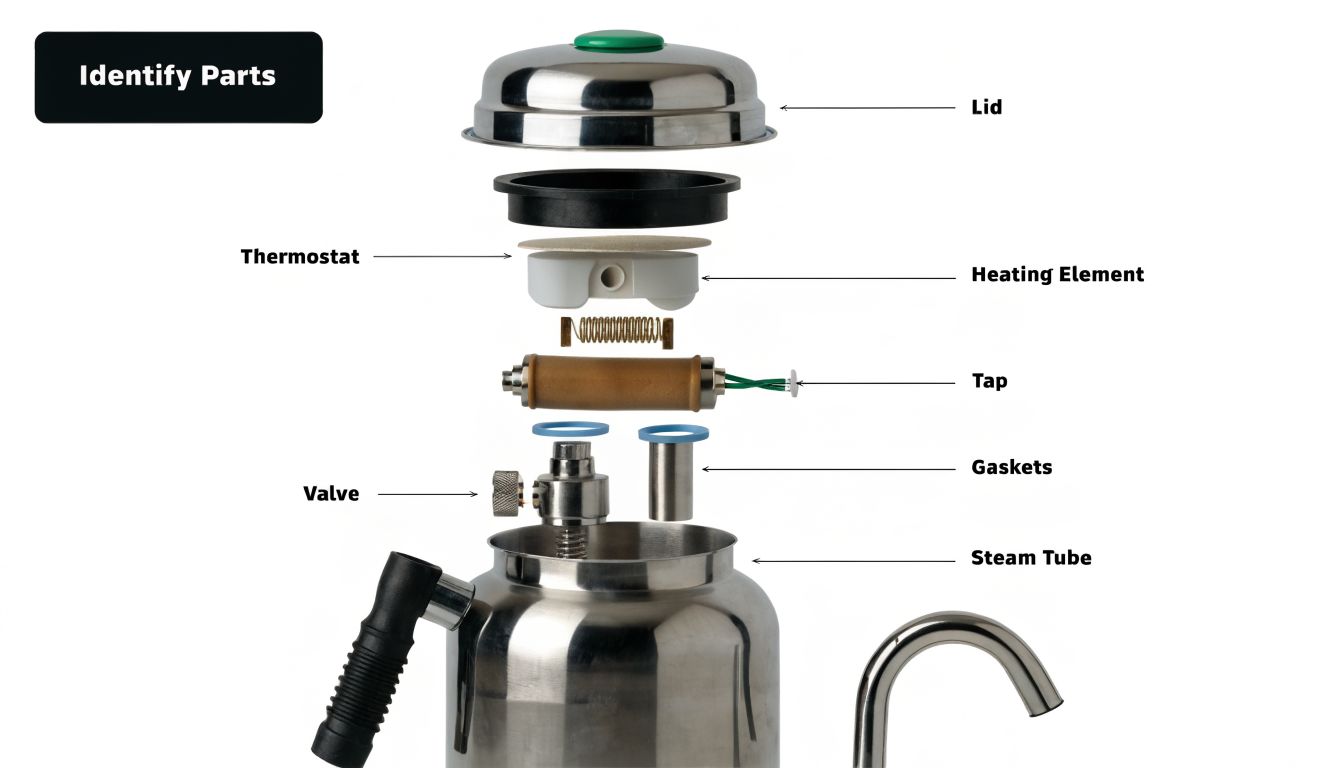
The three assemblies that matter
A standard commercial Birko urn is easiest to think about in three groups.
- Dispensing assembly includes the tap body, handle, spindle, washers or seals, and often the sight glass parts nearby.
- Heating assembly includes the element, thermostat, over-temperature protection, wiring, and any related control components.
- Body assembly includes the lid, vessel, base, handles, and external casing parts.
If the symptom is visible outside the urn, start with the dispensing side first. If the unit fills normally but won't heat, move straight to the heating chain. If the vessel itself is damaged, that changes the repair decision entirely because body failures are a different proposition from service-part failures.
A quick visual walkthrough helps if you prefer seeing parts in place before removing anything.
What the location of the fault usually tells you
Use the fault location as your first filter.
| Fault location | Most likely part area | First check |
|---|---|---|
| Around tap outlet | Tap seal or tap assembly | Drip pattern and handle movement |
| Around sight tube | Sight glass seals or tube | Cracks, looseness, staining tracks |
| Under base or lower body | Element seal area or internal leak | Signs of water after filling |
| Heats poorly or not at all | Element, thermostat, safety cut-out | Power status and heat response |
If you can point to the fault on the urn, you're already halfway to identifying the spare part.
This is why exploded views matter. They turn a vague problem into a named component. Once the part has a proper name, ordering gets much easier.
Birko Part Compatibility Quick Reference Table
Compatibility is where most ordering mistakes happen. Birko urn parts are commonly sold by capacity range in Australia, and supplier listings show parts support across 2.5L to 25L models, with a 2400W element assembly listed for 5L to 25L urns on one supplier page (Birko hot water parts range).
That tells you something important. Some parts are shared across multiple capacities, but not everything is universal. You still need to check how the part mounts, what body size it suits, and whether the urn is from a different generation.
Birko Urn Spare Part Compatibility by Capacity
| Spare Part | 5L-10L Models | 15L-20L Models | 25L+ Models | Notes |
|---|---|---|---|---|
| Heating element | Commonly available across this range | Commonly available across this range | Check listing and model details carefully | A 2400W element is listed for 5L to 25L urns on an AU supplier page |
| Tap assembly | Often model-specific | Often model-specific | Often model-specific | Match thread, body shape, and handle style |
| Thermostat | May vary by urn generation | May vary by urn generation | Compatibility needs checking | Don't assume visual similarity means interchangeability |
| Over-temperature switch | Model-specific check required | Model-specific check required | Model-specific check required | Safety parts need exact match |
| Sight glass and seals | Capacity-specific in many cases | Capacity-specific in many cases | Capacity-specific in many cases | Tube length and seal layout matter |
| Water valve | Check against original assembly | Check against original assembly | Check against original assembly | Best matched by existing part details |
| Tap seals and gaskets | Usually easiest to replace if matched correctly | Usually easiest to replace if matched correctly | Depends on tap design | Small parts, but easy to order wrong if tap style is wrong |
How to use the table properly
Don't read the table as a fitment guarantee. Read it as a shortlist.
Start with these checks:
- Confirm urn capacity from the compliance plate, old invoice, or body label.
- Compare the failed part physically with the product photo and mounting style.
- Check whether the part is sold as a full assembly or a sub-component. This matters with taps and heating sections.
- Treat sight glasses and controls cautiously because they're often more model-specific than buyers expect.
A lot of wasted spend comes from ordering a part that is “close enough”. On urns, close enough often isn't good enough.
Diagnosing Common Birko Urn Failures
Australian servicing practice for Birko urns usually centres on a predictable set of wear items rather than the stainless vessel itself. Local service categories commonly include tap assemblies, water valves, elements, over-temperature switches, heating thermostats, control boards, and tap seals or gaskets, which is why good fault finding starts with the likely wear points rather than assuming the whole urn is finished (Birko parts and maintenance categories).
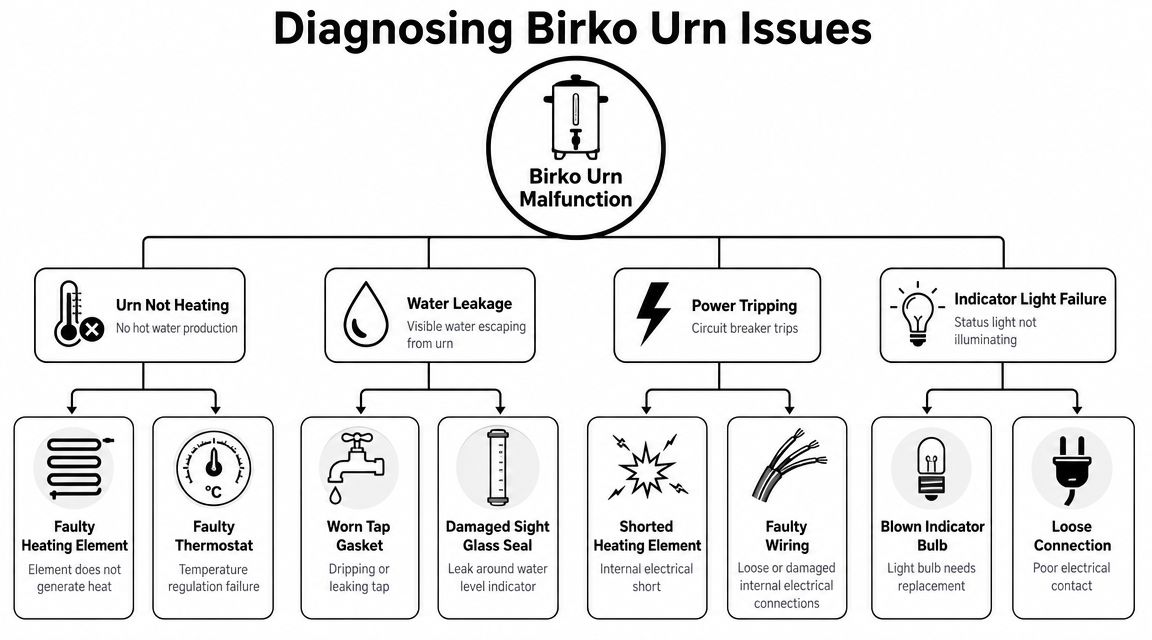
Urn not heating
If the urn powers on but the water stays cold, don't jump straight to replacing the element. That's a common mistake.
Work through it in order:
- Check the obvious first. Plug, outlet, switch position, and whether the urn is energised.
- Listen and feel carefully. A dead-cold urn points you in a different direction from a unit that warms slightly and stops.
- Consider the thermal chain. The likely faults are the element, thermostat, or over-temperature safety device.
- Stop if electrical testing is required. Internal electrical diagnosis belongs to a qualified technician.
If the urn trips power when heating starts, the element moves higher up the suspect list. If it stays powered but doesn't regulate temperature properly, thermostat or control issues become more likely.
Leaking from the tap
A dripping tap is one of the most repairable Birko faults, but only if you isolate whether the problem is the seal or the whole tap body.
Look for these signs:
- Slow drip from outlet usually points to seal wear or internal tap wear.
- Leak around the mounting point can mean the assembly isn't sealing properly to the urn body.
- Loose or rough handle movement often suggests the tap assembly itself is tired, not just the gasket.
A leaking tap doesn't automatically mean the whole urn is worn out. In many cases, it means the dispensing parts have simply reached service age.
Leaking from the body or base
This is the fault that needs more caution. Water tracking from underneath or collecting near the lower section can come from a failed seal, internal connection, or another leak path that isn't visible from outside.
Use a controlled check:
- Empty and dry the urn fully
- Refill and observe where moisture first appears
- Don't run the urn powered if you suspect internal leakage near electrical parts
Base leaks are not a DIY electrical repair. They need proper inspection before the unit goes back into service.
Sight glass problems and false level readings
If the water level indicator doesn't match the actual fill level, the issue is usually mechanical rather than electrical.
Common causes include:
| Symptom | Likely cause |
|---|---|
| Level looks stuck | Scale, residue, or blocked passage |
| Leak around sight tube | Worn seals |
| Cloudy or damaged tube | Age, heat, or cleaning wear |
| Incorrect replacement tube fit | Wrong model-specific part |
When the sight glass is wrong, users often overfill or underfill the urn. That creates knock-on problems, especially in busy kitchens where no one has time to second-guess the level.
A Detailed Guide to Major Birko Spare Parts
The most useful way to identify Birko hot water urn spare parts is by function first, then by rating, shape, and fit. Buyers often do the reverse. They start with a product listing, then try to decide whether it might suit their urn. That usually slows the job down.
A key technical reference in the Australian market is the long-running 2400W/240V element specification. One listing identifies Birko part 1310770 as a 2400W/240V heating element for 10L to 40L urns, and also notes Birko and Zip heritage numbering, which shows how standardised element replacement has carried across multiple urn generations (Birko 1310770 element reference).
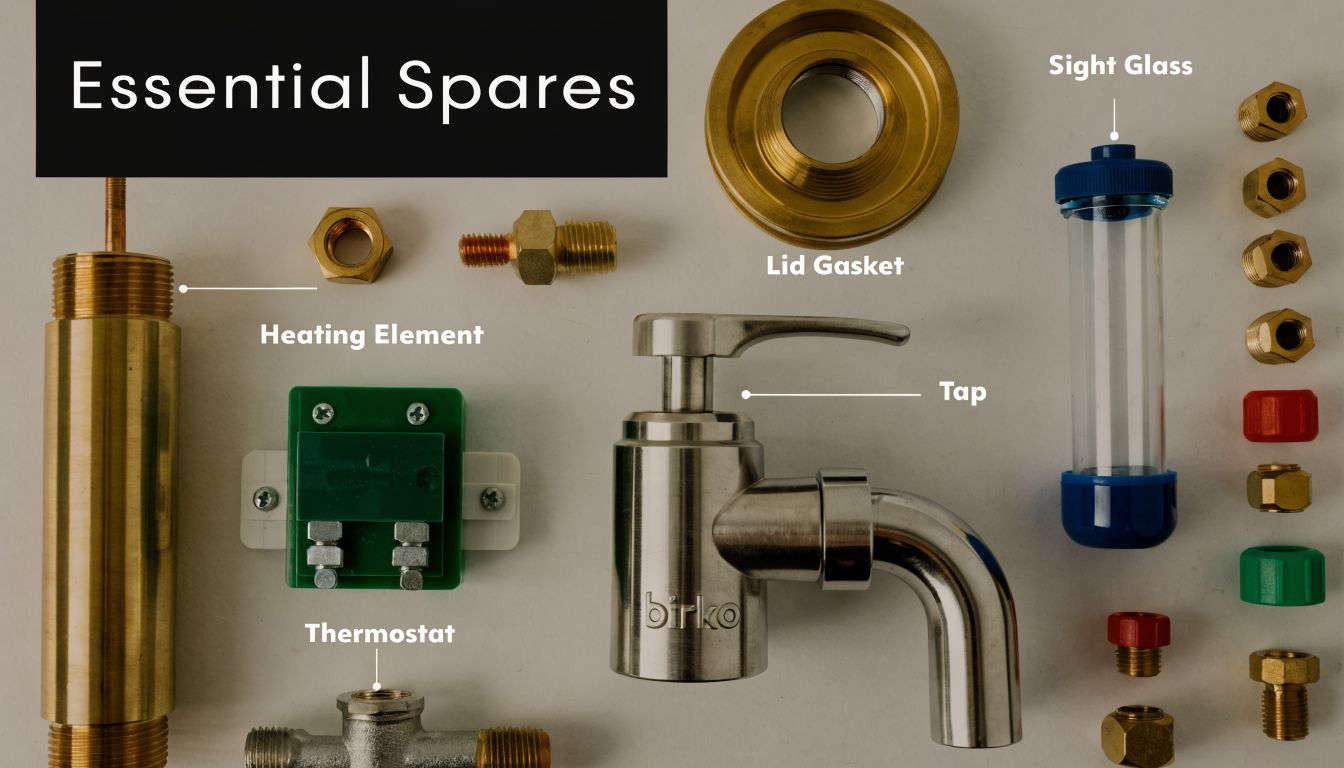
Heating elements
The element does the heavy work, so it's also one of the most important parts to identify correctly.
What matters most:
- Voltage and wattage must match the urn's design.
- Mounting pattern must suit the vessel and bracket arrangement.
- Capacity range helps, but it's not the only check.
- Part heritage matters on older Birko or Birko/Zip-related units.
If you're replacing the heating section, compare the original part markings and layout against the product listing. A dedicated option such as the Birko 1311032 hot water element is the sort of product that should be matched by actual urn details, not by assumption.
Taps and dispensing assemblies
Taps fail in more than one way. Some start dripping. Others stiffen up, crack, or no longer seal cleanly after repeated use.
There are two practical replacement paths:
- Seal-only repair, when the tap body is still sound.
- Complete tap assembly replacement, when wear is spread through the spindle, handle, or body.
The trap here is ordering by appearance. Two taps can look similar in a catalogue and mount differently on the urn wall. Always compare thread style, body length, and handle orientation.
Thermostats and safety controls
These parts are less visible, but they matter more than many buyers realise. A thermostat controls heat cycling. An over-temperature device is there to interrupt unsafe overheating. A control fault can look like an element fault if you diagnose too quickly.
Signs you're in this category:
- Urn heats erratically
- Water gets too hot or not hot enough
- Heating cuts in and out unpredictably
- Power is present but thermal behaviour is wrong
These are not universal parts. They must suit the original electrical and thermal design.
Safety controls need exact replacement parts. “Near enough” isn't acceptable on an urn that heats water in a shared workplace or commercial setting.
Seals, gaskets and sight glass parts
These are the small parts that stop a simple fault becoming a messy one. A worn seal can turn a usable urn into a constant drip problem. A tired sight glass seal can create leaks that get mistaken for bigger failures.
Check these details before ordering:
| Part type | What to compare |
|---|---|
| Tap seal | Tap design and internal sealing style |
| Body gasket | Seating shape and diameter |
| Sight glass seal | Tube diameter and mounting arrangement |
| Sight glass tube | Length and end fit |
These parts are often inexpensive compared with major electrical components, but they're some of the easiest to get wrong if the urn model isn't confirmed.
Control boards and less common parts
Some Birko urns include control components beyond the basic thermostat and safety chain. If a board is involved, diagnosis gets more technical and less suitable for trial-and-error ordering.
Use board replacement only when:
- the fault has been isolated properly,
- the rest of the heating chain has been checked,
- and the replacement board matches the urn exactly.
That's the broader rule across all major parts. Identify the failed function, then confirm the physical and electrical match.
Step-by-Step Installation Notes for Common Repairs
Some Birko repairs are straightforward. Others involve live electrical components, protective devices, and sealing points that shouldn't be handled casually. The dividing line is simple. Tap and sight glass work can be manageable for a careful person. Element, thermostat, safety switch, and internal wiring work should be done by a licensed professional.
Before any repair
Start the same way every time.
- Disconnect power completely. Unplug the urn and keep it unplugged.
- Drain all water. Don't work on a partially filled urn.
- Let the unit cool fully. Hot residual water catches people out.
- Move it to a stable bench with enough room to set parts down in order.
- Photograph the part before removal if there's any chance you'll need to compare orientation later.
Useful tools usually include a spanner set, screwdrivers, soft cloths, and food-safe cleaning materials for the sealing surfaces.
Replacing a non-drip tap assembly
This is one of the most common Birko urn spare parts jobs.
What you'll need
- Correct replacement tap or tap assembly
- Spanner or suitable wrench
- Cloth or towel
- Possibly a new sealing washer if supplied separately
Installation steps
- Empty and dry the urn wall around the tap. You need a clean surface to spot any fresh leak later.
- Hold the inner fitting if accessible and loosen the external tap assembly carefully. Don't twist against the body aggressively.
- Remove the old assembly and inspect the sealing surfaces. Look for distortion, residue, or scale that could stop the new part sealing.
- Clean the mounting area thoroughly. A new tap won't seal properly against old mineral build-up.
- Fit the new seal or washer in the correct orientation. If it sits unevenly, start again.
- Install the new tap hand-tight first, then tighten firmly without over-stressing the body.
- Refill with cold water and check for seepage before reconnecting power.
If the tap still drips after replacement, don't assume the new part is faulty. Check whether the issue is from the mounting seal, not the outlet.
Replacing a sight glass tube or seals
Sight glass repairs are simple in concept but fussy in practice. Most problems come from pinched seals, incorrect tube length, or overtightening.
What you'll need
- Correct sight glass tube
- Matching upper and lower seals
- Soft cloth
- Small hand tools if the housing requires them
Installation steps
- Drain the urn below the sight glass level or fully empty it.
- Remove the old tube and seals carefully. Don't chip surrounding fittings.
- Clean the upper and lower seating points. Even minor scale can stop a good seal.
- Check the replacement tube length against the old one before fitting.
- Seat the new seals evenly. Don't force them in dry if the design needs careful placement.
- Install the tube squarely. If it sits on an angle, remove it and start again.
- Refill slowly and inspect both ends for leaks.
If a sight glass leaks only after the urn warms up, the seal may be slightly twisted or the tube may not be seated correctly.
Jobs that are not DIY
Do not attempt these without the right licence and test procedures:
- Heating element replacement
- Thermostat replacement
- Over-temperature switch replacement
- Internal wiring repairs
- Control board diagnosis
Those repairs need electrical safety checks before the urn goes back into service.
Sourcing Parts and Professional Repair in Melbourne
A common Melbourne callout goes like this. The urn is leaking, staff still need boiling water, and someone has already ordered a part based on capacity alone. That is how a quick fix turns into wasted time. Birko urns can share similar sizes while using different taps, seals, sight glass sets, or internal components, so the model code matters more than a rough visual match.
Part cost is only half the decision. The other half is whether the urn is worth saving once you identify the failed component correctly. Some genuine Birko parts are expensive enough to change the repair equation, especially on older units with scale build-up, worn fittings, or a tired element. A parts listing such as this Birko spare parts pricing example shows why it makes sense to compare the cost of the part, labour, and downtime before ordering.
When repair makes sense
Repair is usually the right call if the urn body is clean, the fault is limited to one known part, and the rest of the unit is in serviceable condition. That often applies to taps, tap seals, lid parts, sight glass tubes, and similar external items.
It also makes sense when you can confirm the full model details before ordering. That one step prevents a lot of wrong-part returns.
If the job has moved beyond a simple external part swap, a local Birko urn repair and service in Melbourne booking can save time, especially where the unit needs fault isolation, electrical testing, or a decision on whether repair is still economical.
When replacement is the smarter call
Replacement usually wins when the urn has more than one meaningful fault. An urn with a leaking outlet, unstable temperature control, and a scaled or stained vessel is rarely a cheap repair once parts and labour are added together.
Use this decision filter:
| Condition | Usually points toward |
|---|---|
| One confirmed mechanical fault | Repair |
| Internal electrical fault with other wear present | Assess full repair cost first |
| Vessel damage, heavy corrosion, or repeated leaks | Replace or refurbish professionally |
| Commercial site where downtime affects service | Choose the fastest reliable option |
For businesses bringing in catering equipment or stocking replacement units from overseas, supply timing can affect that choice as much as part price. If the replacement urn or bulk parts order is arriving from offshore, understanding air and sea freight customs clearance can help avoid hold-ups after the shipment reaches Melbourne.
The practical rule is simple. If the urn has one clear fault and the vessel is still sound, repair is usually justified. If faults are stacking up, replace it before another failed part puts it out of service again.
Birko Spare Parts Frequently Asked Questions
Can I use non-genuine parts in my Birko urn
You can physically fit some non-genuine or universal parts to an urn, but that doesn't mean you should. The problems usually show up as poor sealing, awkward fit, unreliable temperature behaviour, or safety concerns with electrical components.
For mechanical items like taps and seals, a poor match often means repeat leaks. For electrical items like elements, thermostats, and safety parts, the risk is higher because the replacement needs to suit the urn's original thermal and electrical design.
Do replacement Birko parts come with a warranty
Warranty terms depend on the supplier and the specific part. Because terms vary, check the product listing or ask the seller before ordering.
The practical point is this. Keep your invoice, keep the part number, and keep a note of who installed it if the part is electrical. That makes any follow-up much easier.
What should I check after a repair
Always do a basic return-to-service check before normal use.
- Check for leaks around the repaired area while the urn is filled with cold water.
- Confirm all covers and fasteners are secure before reconnecting power.
- Watch the first full heat cycle if the repair was mechanical but near a heated section.
- Stop immediately if water appears near the base or electrical area.
Is it better to replace a part or replace the whole urn
It depends on the body condition, the failed component, and how critical uptime is. A simple tap or sight glass fault is very different from a major electrical failure in an older commercial urn.
If the vessel is sound and the fault is isolated, repair usually makes sense. If faults are stacking up, replacement or professional assessment is the safer path.
What's the biggest mistake people make when ordering Birko hot water urn spare parts
They order from a photo without confirming the urn model, capacity, or part layout. That's how buyers end up with the wrong tap, wrong sight glass, or a control part that looks close but doesn't belong in the unit.
Match the urn first. Match the part second. Doing it the other way around is what creates returns, delays, and repeat faults.
If you need help identifying the right part or deciding whether your urn is worth repairing, Ring Hot Water supplies Birko-compatible spare parts and supports repair enquiries for Melbourne customers and Australia-wide parts orders.

