
Water pumps
A Practical Guide to Your 12V Water Pump
Mar
Ever wondered how you get running water in a caravan, boat, or a remote weekender? The secret is a small but mighty device: the 12V water pump. It’s the key piece of kit that creates a pressurised water system using a low-voltage DC power source, like the battery in your vehicle.
This little workhorse gives you the simple convenience of a tap or a hot shower, even when you're miles from the nearest mains connection.
The Heart of Your Mobile Water System
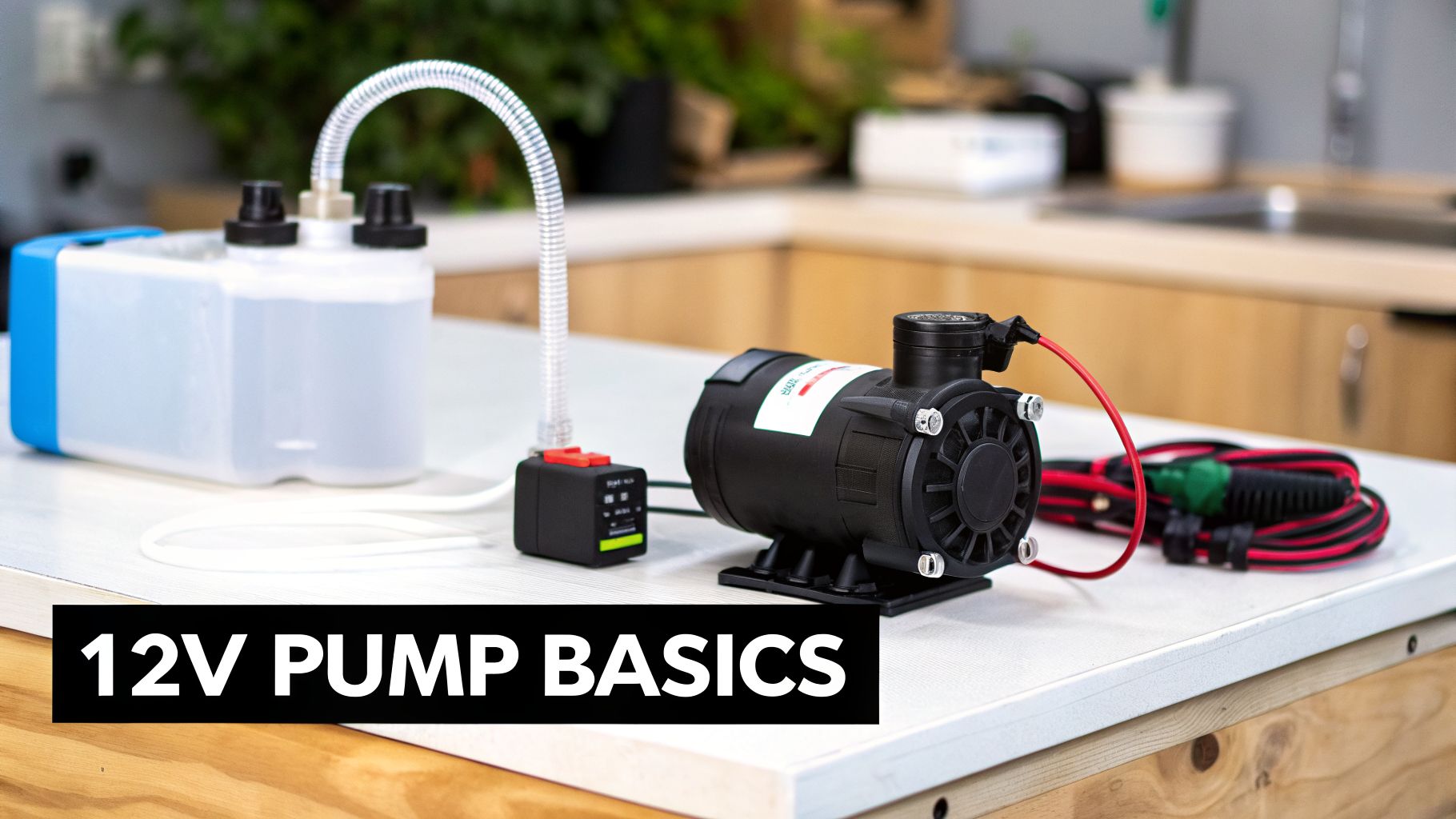
Think of a 12V water pump as the heart of your entire off-grid water setup. Its job is simple but absolutely essential: it draws water from your storage tank and pushes it through the pipes to your taps, shower, or portable hot water heater. It’s what turns a basic caravan or cabin into a space with all the comforts of home.
What makes these pumps so perfect for the job is their blend of efficiency and safety. Because they run on a simple 12-volt system, they're much safer to install and work on yourself compared to high-voltage 240V pumps. They’re also designed from the ground up to be incredibly energy-efficient, which is a massive plus when you're trying to make your battery last as long as possible.
So, Why Is a 12V Pump a Must-Have?
You really see the value of a 12V water pump in day-to-day life on the road. For a family out in their RV for the weekend, it means being able to wash the dishes after dinner or rinse off under a hot shower after a day at the beach. For a mobile coffee van or food truck, a reliable pump is non-negotiable for running sinks and staying compliant with health codes.
To help you see where these pumps fit in, here's a quick look at their most common uses.
Common Applications for 12V Water Pumps
| Application Area | Primary Use Case | Key Benefit |
|---|---|---|
| Caravans & RVs | Supplying water to kitchens and bathrooms. | Enables home-like comfort and hygiene on the road. |
| Boats | Providing fresh water for galleys and deck showers. | Compact and safe for marine electrical systems. |
| Off-Grid Cabins | Pumping water from a tank to the house. | Low power draw is ideal for solar/battery setups. |
| Mobile Food/Coffee | Running sinks and coffee machines. | Essential for health compliance and operations. |
| Camping & 4WD | Powering portable showers and camp kitchens. | Turns a basic campsite into a comfortable base. |
| Agriculture | Spot spraying or water transfer in the field. | Highly portable and runs directly off vehicle power. |
Ultimately, these pumps offer one thing above all else: freedom.
The core benefit is independence. A 12V pump untethers you from fixed plumbing, giving you the freedom to have pressurised water wherever your vehicle or setup can go. It’s the key to making a mobile space feel more like home.
This drive for mobile solutions is clear in the market. The broader Australian water pumps market hit an estimated USD 1.7 billion in 2024, and the demand for compact 12V systems is a big part of that. Here in Melbourne, we see it every day with caravan and RV owners coming into specialists like Ring Hot Water in Sunshine, looking for the right pump and the 12mm fittings needed to get their setups just right. If you’re interested, you can explore more data on the Australian water pumps market to see these trends for yourself.
How to Choose the Right 12V Pump
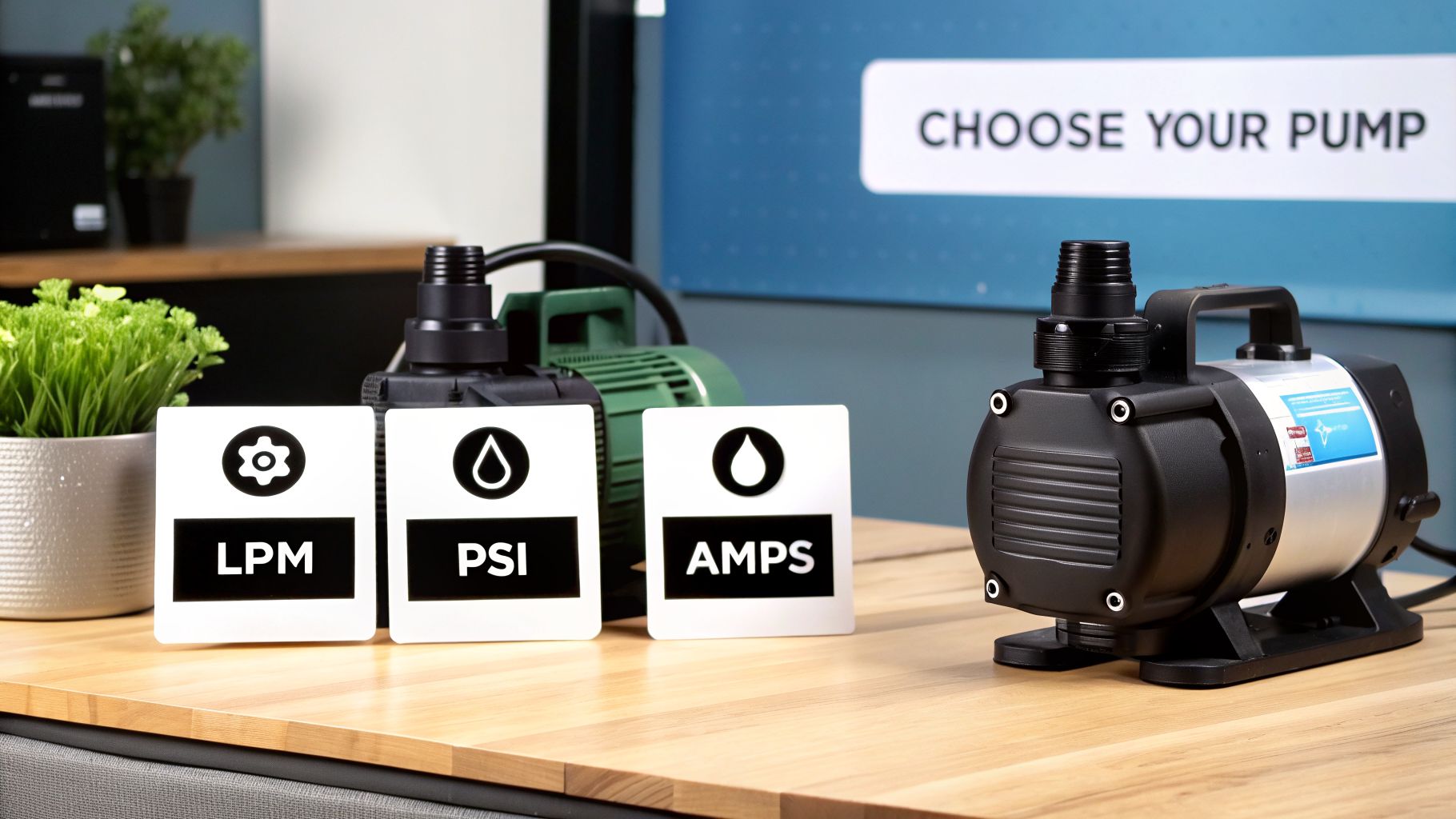
Choosing the right 12V water pump can feel like you’re trying to crack a code, with acronyms like LPM, PSI, and amps flying around. But getting this right from the start is the secret to a water system that works for you, not against you. It's all about matching the pump's specs to how you actually live and travel.
Let's cut through the technical talk. Think of it this way: flow rate is how much water you get, pressure is how hard it comes out, and amperage is how much juice it sips from your battery. Each one is a critical piece of the puzzle.
Getting to Grips with Flow Rate and Pressure
Flow rate, measured in Litres Per Minute (LPM), is all about the volume of water the pump can push through. A higher LPM is what gives you a decent shower in the caravan—because let's be honest, no one wants a miserable trickle. For a family on a weekend trip, you’ll want a pump that can deliver at least 11 LPM to handle a good shower or multiple taps at once.
Then there's pressure, measured in Pounds per Square Inch (PSI), which is the force behind the water. While high pressure is great for blasting mud off your gear, you only need a steady, consistent pressure for the kitchen sink. A good all-rounder for most caravan and RV setups is something around the 40 PSI mark. It's always a good idea to understand your system's needs; if you're new to this, it can be useful to check water pressure in your home to get a feel for what different levels are like.
This push for reliable water on the go is a growing trend. Australia's imports of automotive electric water pumps—mostly 12V models—jumped by 6.0% from 2023 to 2024. For those of us with caravans and RVs, especially around major hubs like Melbourne, this means we're getting better access to top-notch pumps and all the fittings to go with them.
Matching Amperage Draw to Your Battery
The amperage draw, or amps (A), tells you how much electrical current the pump needs. This is absolutely crucial for off-grid setups because a power-hungry pump will drain your battery in no time. If you’re just running a simple under-sink filter, a low-amperage pump is the smart way to go to avoid putting unnecessary strain on your power system.
Think about how you'll use it:
- The Weekend Warrior: An 11 LPM pump pulling 7-8 amps is a great balance for hot showers and washing up.
- The Simple Camp Kitchen: A smaller 4-5 LPM pump that only draws 3-4 amps is perfect for a single tap and will keep your battery happy.
- Full-Time Off-Gridder: You might lean towards a high-efficiency pump, even if it means a slightly lower flow rate, to get the most out of every amp.
Diaphragm Pumps vs. Submersible Pumps
The most common pump you'll come across is the diaphragm pump. These are the workhorses of the RV and marine worlds for a reason. They are self-priming, can run dry for a bit without being damaged, and have a built-in pressure switch that cleverly turns the pump off when you close the tap.
Submersible pumps, on the other hand, are designed to sit directly inside your water tank. They tend to be quieter, but they aren't really built for pressurised systems without some extra components. For almost every caravan application, a diaphragm pump is your best bet.
To see how these pumps fit into a complete system, have a look at our guide on choosing a 12 V water pump for a caravan.
Pro Tip: Always check if a pump has a built-in thermal overload protector. This brilliant little feature will automatically shut the pump down if it overheats, saving the motor from burning out and giving you one less thing to worry about.
Getting Your Toolkit and Parts Ready
There’s nothing worse than getting halfway through a job and realising you’re missing a crucial fitting or the right screwdriver. For a 12v water pump installation, a bit of prep work goes a long way. It’s the difference between a smooth, leak-free setup and a trip back to the hardware store covered in water.
Before you even think about touching a wire or a hose, get everything you need and lay it all out. This isn't just about ticking off a list; it's about making sure you have the right gear to do the job properly and safely.
The Essential Tools for the Job
You don’t need a full-blown workshop, but a few specific tools will make your life a whole lot easier. Having the right tool prevents stripped screws, leaky connections, and electrical gremlins down the track.
- A decent screwdriver set: You'll need both Phillips head and flathead drivers for mounting the pump and tightening hose clamps without chewing them up.
- Wire strippers and crimpers: This is all about creating clean, solid electrical connections. A dodgy crimp is one of the most common failure points in any 12V system.
- Drill with a few bit sizes: Essential for drilling pilot holes so you can mount your pump securely.
- Adjustable spanner or pliers: Perfect for nipping up threaded fittings without scratching or cracking them.
- Hose cutter or a sharp utility knife: A clean, straight cut on your water lines is the secret to a perfect, drip-free seal.
Your Non-Negotiable Parts Checklist
Aside from the pump itself, there are a few other bits and pieces that are absolutely vital for a safe and long-lasting system. Trying to save a few dollars by skipping these is a false economy that can lead to pump damage or, worse, an electrical hazard.
First up, the inline fuse. Think of this as the single most important safety device in the whole circuit. It’s not just protecting the pump; it’s protecting your battery and wiring. If the pump jams or shorts out, the fuse blows, cutting the power and preventing a potential fire. It's completely non-negotiable.
A pre-filter or strainer is your pump's best mate. It sits on the inlet side, catching any grit or gunk from your water tank before it chews up the pump's delicate diaphragm and valves. This simple part can easily double the life of your pump.
Finally, round up all your plumbing bits:
- Flexible Hoses: Make sure you get food-grade hosing with the right diameter to match your pump’s inlet and outlet ports.
- Hose Clamps: Always go for stainless steel clamps. They won't rust and will give you a tight, reliable seal that lasts.
- Fittings: You might need a mix of threaded or barbed fittings to connect your hoses to the pump, tank, and taps.
Making sure you have a solid power connection is also key. If you’re just setting up a temporary system or want to test your pump before a full install, a dedicated 12V water pump power adapter is an incredibly handy tool. It takes all the guesswork out of the wiring and gives you a safe, regulated power source.
Installing Your 12V Water Pump
Alright, with the right pump in hand, it's time for the fun part: getting it installed and bringing your water system to life. Setting up a 12V water pump is a straightforward job, but taking a careful, methodical approach is the key to a reliable and leak-free system that you can trust for years to come.
Let's walk through picking the perfect spot, getting the plumbing hooked up, and wiring it safely. Think of it as a weekend project that pays off every time you turn on the tap.
Finding the Ideal Mounting Location
Where you decide to mount your pump makes a surprising difference to how well it works and how long it lasts. You're looking for a spot that’s dry, has a bit of airflow to keep it from getting too hot, and is as close as you can get to your water tank and your battery.
Shorter hose and wire runs mean the pump doesn't have to work as hard, which is always better for efficiency and longevity. You'll also want to think about noise. While modern pumps are pretty quiet, their vibrations can be amplified. Bolting it directly to a thin interior wall is a great way to create an annoying hum, whereas tucking it away in a storage locker or under a seat is usually a much better bet.
Pro Tip: Don't skip installing the rubber feet that come with the pump. They're not just for show! These are specifically designed to absorb vibrations, which makes the pump significantly quieter and stops it from rattling its own screws loose over time.
This diagram gives you a quick visual on the key parts you'll be putting together.
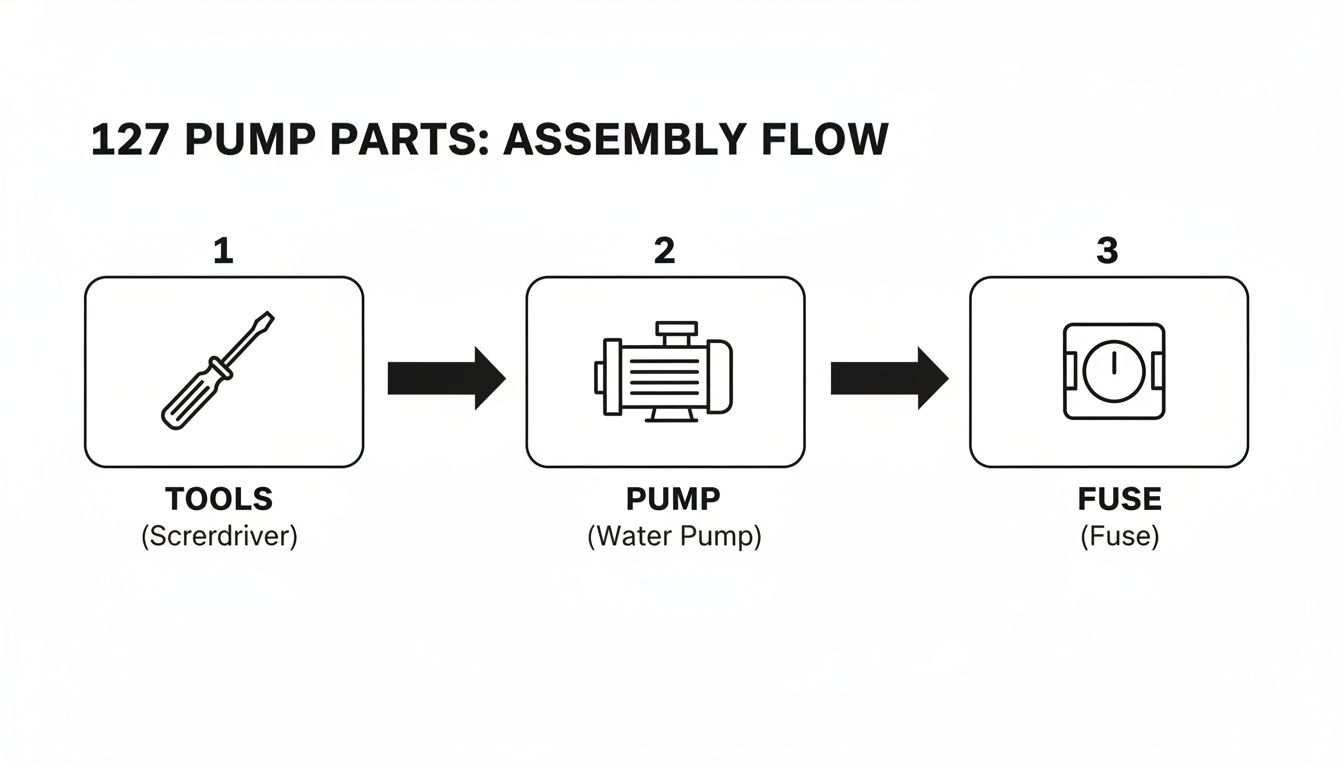
The flow is simple: you'll mount the pump, then wire in a fuse to protect the whole circuit.
Connecting the Plumbing Securely
Once the pump is mounted, it’s time to hook up the water lines. Most people use flexible, food-grade hose for both the inlet (coming from the tank) and the outlet (heading to your taps). Check the pump head for little arrows indicating the direction of water flow—getting this right is crucial.
A clean, straight cut on your hose is the first step to a good seal. Shove the hose firmly over the barbed fitting on the pump, making sure it goes all the way on. Then, slide a stainless steel hose clamp to about a centimetre from the end of the hose and tighten it down. You want it snug, but be careful not to crank on it so hard that you crack the plastic fitting.
From there, just run your outlet hose to your taps or water heater. Do your best to avoid any sharp bends or kinks, as these can seriously restrict water flow and make the pump work harder than it needs to.
Wiring Your Pump for Safety and Performance
The last piece of the puzzle is the electrical hookup, and this is where you need to be extra careful. Always disconnect the negative terminal from your 12V battery before you start playing with wires. It’s a simple step that completely removes the risk of short circuits or getting a nasty shock.
The good news is that wiring a 12V pump is incredibly simple. You’ll have a positive (red) wire and a negative (black) wire.
- The negative (black) wire connects directly to a solid earth point on your vehicle’s chassis or to the negative bus bar in your electrical setup.
- The positive (red) wire runs from the battery, through a fuse, through a switch, and then connects to the pump's positive terminal.
Don't be tempted to skip the fuse or the switch. The switch lets you kill power to the pump when you're not using it or when you need to do maintenance. The fuse is your most important safety device. It’s designed to blow and cut the circuit if something goes wrong, preventing a potential fire. Your pump’s motor label should tell you the correct fuse rating to use.
Wiring Your 12V Pump A Simple Breakdown
To make it crystal clear, here’s a quick table showing how everything connects. Following this ensures your pump runs correctly and, more importantly, safely.
| Connection Point | Wire From | Wire To | Important Note |
|---|---|---|---|
| Pump Negative | Pump’s Black Wire | Chassis Earth or Negative Bus Bar | Ensure a clean, secure connection for a good ground. |
| Pump Positive | Pump’s Red Wire | Output Terminal of Switch | This wire receives power only when the switch is on. |
| Switch | Input Terminal of Switch | In-Line Fuse Holder | This provides power to the switch. |
| Fuse | In-Line Fuse Holder | Positive Battery Terminal | Must be the correct amp rating for your pump. |
Once you’ve got everything wired up, give it all one last check to make sure your connections are tight and in the right place. Only then should you reconnect your battery’s negative terminal. Now, flick the switch, open a tap, and enjoy the satisfaction of your new pressurised water system.
Troubleshooting Common Pump Problems
Even the most reliable 12V water pump can have an off day. Before you jump to the conclusion that you need a full replacement, it’s worth knowing that most common issues are surprisingly simple to diagnose and sort out with a bit of methodical thinking. Let’s walk through the usual suspects and get your water flowing again.
The good news is that modern pumps are tougher than ever. The national water pump market, valued at a whopping AUD 263.40 million in 2024, has driven a lot of innovation. For caravan owners, this has meant newer 12V pumps have helped drop failure rates in RV water systems by a solid 25%. But that doesn’t mean they’re invincible. Local service logs in Melbourne, for instance, show that 18% of repairs still trace back to 12V components like valves and hoses, so knowing your way around a basic troubleshoot is a skill that pays off.
The Pump Is Running but No Water Is Coming Out
This has to be one of the most common and frustrating problems. You can hear the motor buzzing away, doing its thing, but the tap remains stubbornly dry. Nine times out of ten, the problem isn’t a dead pump—it’s air.
An airlock in the inlet hose is a classic cause, especially if you’ve just refilled your tank or accidentally run it dry. The pump ends up just spinning air instead of pulling water, so it can’t build up the suction it needs. Another prime suspect is a clogged pre-filter or strainer. If that’s blocked with gunk, water can’t even get to the pump to begin with.
Here’s the game plan:
- Start with the strainer. It’s the easiest thing to check. Switch the pump off, unscrew the clear bowl on your pre-filter, and give that little mesh screen a proper clean.
- Bleed the air out. With the pump still off, slightly loosen the fitting on the outlet side (the ‘out’ pipe). Flick the pump on for just a few seconds until you see water sputter out, then quickly tighten it back up.
- Give the inlet hose a once-over. Make sure it isn’t kinked and that every connection is sealed tight. Even a tiny air leak on the suction side is enough to prevent it from priming properly.
The Pump Keeps Cycling On and Off
You know the sound—the pump kicks on for a second, shuts off, then kicks on again, over and over, even when every tap is tightly closed. This constant cycling is almost always caused by a pressure drop somewhere in your system. The pump does its job, gets the lines up to pressure, and switches off like it’s supposed to. But then, the pressure immediately starts to fall, forcing it to turn back on.
This usually points to one of two things: a tiny leak or a dodgy pressure switch.
A very slow, sneaky drip from a loose fitting or a hairline crack in a connection is often the culprit. Less commonly, the pressure switch itself might be on its way out, unable to hold the pressure setting. To figure it out, your first job is to meticulously inspect every single plumbing joint, from the pump right through to the taps, for any sign of moisture.
Here’s a trick I use to find those really sneaky leaks: dry every fitting completely with a bit of paper towel. Leave it for ten minutes, then go back and check each one again for any hint of dampness. It’s simple, but it works.
The Pump Is Excessively Loud or Vibrating
No pump is whisper-quiet, but if yours has suddenly started making a racket or vibrating violently, that’s a clear signal something’s amiss. The most frequent cause is simply the pump’s vibration being transferred to the surface it’s mounted on.
First, check that the pump is still bolted down securely. Have a look at its rubber mounting feet—if they’ve perished or compressed, they won’t absorb the vibration anymore. If the noise is more of a gravelly, grinding sound, you could have some debris rattling around inside the pump head, which can happen if you’ve been running without a strainer. For a deeper dive into general pump maintenance and repair services, there are some excellent specialised resources out there.
Your 12V Water Pump Questions Answered
We get asked a lot of the same questions when it comes to setting up a reliable 12V water pump system. It’s one of those things that seems simple on the surface, but a few key details can make all the difference. Let’s run through the most common queries we hear from customers.
How Long Will a Pump Run on My Caravan Battery?
This is the big one, and the answer really comes down to two key numbers: your pump’s amperage draw and your battery’s capacity in Amp-hours (Ah).
A typical caravan pump pulls around 5-7 amps when it’s running. On a standard, healthy 100Ah battery, you could technically run it for several hours straight. But of course, that’s not how we use them. You’re only running it for a few minutes for a shower or maybe 30 seconds to fill the kettle. For a normal weekend away, a fully charged battery will handle your water needs with plenty to spare.
Do I Really Need an Accumulator Tank?
Technically, no. Your system will pump water without one. But in my experience, an accumulator tank is one of the single best upgrades you can make to your 12V setup.
Think of it as a small pressure buffer that lives next to your pump. It smooths out the water flow, getting rid of that pulsing you sometimes see, and it stops the pump from kicking on and off every time you just want to quickly rinse your hands.
An accumulator tank doesn’t just make your system quieter and feel more like a home tap; it also drastically cuts down on the wear and tear of your pump’s pressure switch. It’s a small investment that pays off in both performance and the longevity of your pump.
Can I Use a 12V Pump for Hot Water?
Absolutely. Most quality diaphragm pumps on the market are built to handle hot water, usually with a maximum temperature rating of around 60°C.
This makes them perfect for feeding an instant gas hot water heater in a caravan or even a compact boiling water unit under a sink. Just be sure to check the manufacturer’s specs before you purchase. For most setups, a standard 12V water pump is more than up to the task.
For a deeper dive, we have a whole series of guides on building the perfect RV water system.
Ready to upgrade your system or chasing a hard-to-find part? The team at Ring Hot Water offers genuine expert advice and the right products to get your project sorted. Check out our full range of pumps and fittings online.
Shop 12V Water Pumps and Fittings at Ring Hot Water
