
Water Valves
Your Essential Guide to the Shut Off Valve
Mar
When a pipe bursts or a tap just won't turn off, that feeling of panic is all too real. But what if you had a master switch for your home’s water system? That’s exactly what a shut off valve is—your ultimate control, giving you the power to stop the flow of water in its tracks.
It’s the simple device that can turn a potential flood into a minor inconvenience, saving you a fortune in water damage repairs.
The Most Important Plumbing Device You've Never Thought About
Think of a shut off valve like the main power switch in your home's fuse box. If an appliance starts sparking, you don't hesitate to flick the circuit breaker to prevent a fire. A shut off valve does the same job for your plumbing. When a tap explodes or a pipe gives way, this valve lets you cut the water supply and prevent a watery disaster.
It's a simple, crucial bit of gear. Yet, for many homeowners, it only comes to mind during a frantic, wide-eyed search while water is already pooling on the floor. Just knowing what it is and where to find it is the first step to taking control of your home’s plumbing.
Your First Line of Defence Against Water Damage
Every single property, whether it’s a house or a business, has a main water shut off valve. This is the big one—the primary control that stops all water from entering your property. In a true emergency, like a burst hot water system or a major leak, this is the valve you need to find and turn off immediately.
But it doesn't stop there. You'll also find smaller, individual shut off valves (often called 'stops' or 'angle stops') that give you localised control over specific fixtures. You’ll almost always find these:
- Tucked away underneath the kitchen and bathroom sinks
- Behind the toilet, usually near the floor
- On the water lines connecting your washing machine or dishwasher
- Leading into your hot water heater
These smaller valves are brilliant. They let you do basic maintenance—like changing a tap washer or hooking up a new appliance—without having to turn the water off for the entire house.
Knowing the location of both your main shut off valve and your individual fixture valves is non-negotiable for any property owner. A few minutes spent locating them now can save you thousands of dollars and immense stress later.
Gaining Control and Confidence
The real power of a shut off valve is its simplicity. Most modern types, like ball valves, work with a quick quarter-turn of a lever handle. Some older styles, like gate valves, have a wheel-like handle that you need to turn a few times to close it completely.
Once you’re familiar with these, you can shift from a state of helpless panic to one of prepared control. You no longer have to stand by and watch the damage spread while you wait for a plumber. You can take immediate action, isolate the problem, and then call for professional help from a place of safety. This guide will help you build that confidence, starting with this unsung hero of your home's plumbing.
Decoding the Different Types of Shut Off Valves
Stepping into the world of plumbing can feel like learning a new language, especially when it comes to the different valves controlling your water. While they all do the same basic job—stopping or starting water flow—not every shut off valve is built the same. Each type has a unique design for specific tasks, from giving you an instant, emergency stop to allowing for precise flow adjustment.
At its core, a shut off valve is your first line of defence, acting as a crucial barrier between your home and the main water supply. Think of it as the master switch for your plumbing.
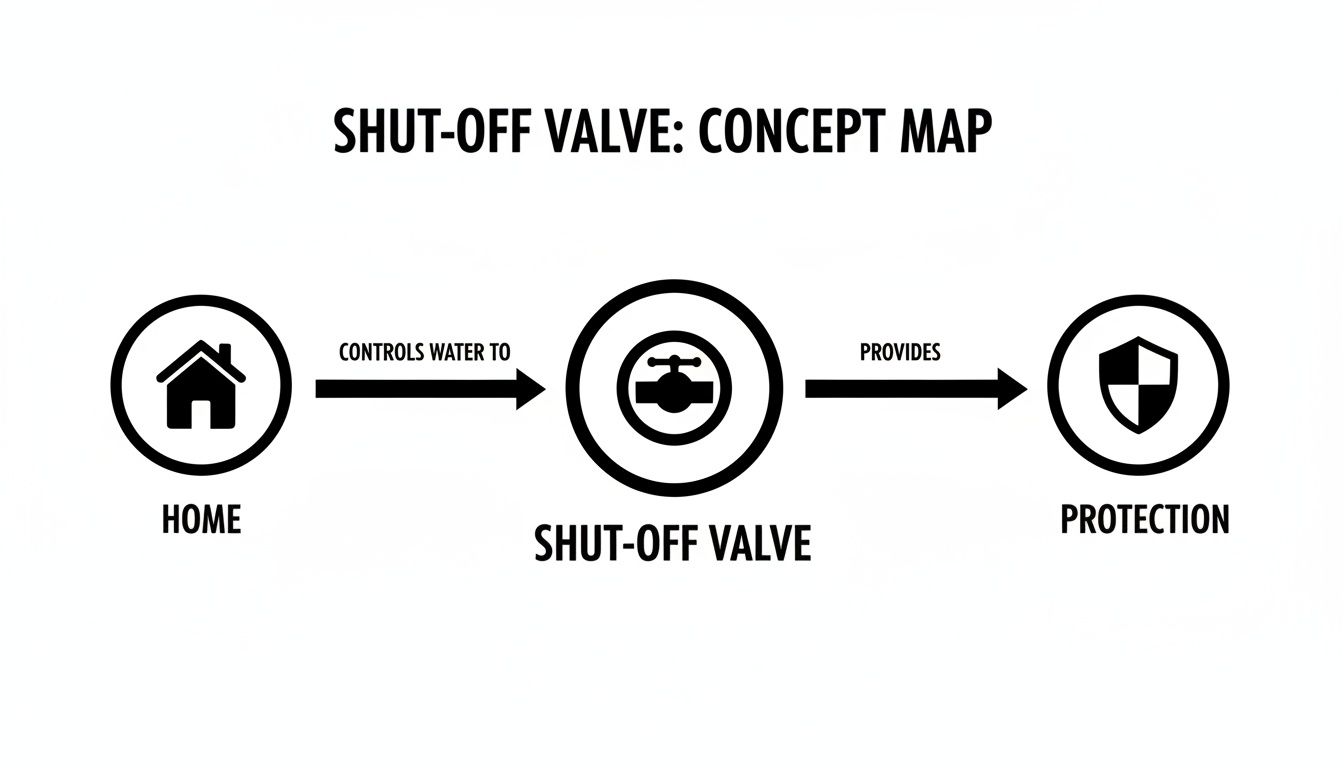
This simple concept empowers you to protect your property from water damage. Getting to know the main varieties is the next step to mastering your home's plumbing.
Shut Off Valve Comparison at a Glance
To make things easier, here's a quick rundown of the common valve types you'll encounter. This table should help you identify what you have and what it's best for.
| Valve Type | Operation | Best For | Pros | Cons |
|---|---|---|---|---|
| Ball Valve | Quarter-turn lever | Fast, complete shut-offs (e.g., main water line) | Durable, reliable, clear open/closed visual | Not for flow adjustment (throttling) |
| Gate Valve | Multi-turn wheel | Gradual shut-offs in older systems | Gentle flow cut-off, prevents water hammer | Prone to seizing or breaking over time |
| Globe Valve | Multi-turn handle | Precise flow control and regulation | Excellent for adjusting flow volume | More restrictive to flow than ball/gate valves |
| Angle Stop Valve | Quarter-turn handle | Isolating individual fixtures (sinks, toilets) | Allows fixture repair without a full water shut-off | Smaller size, only for individual appliances |
Each valve has its place, and understanding the pros and cons makes troubleshooting a whole lot simpler.
The Workhorse: Ball Valves
If there's a modern standard for shut off valves, it's the ball valve. You can spot it instantly by its lever handle, and it's the very definition of simple and reliable.
Inside, there’s a sphere with a hole drilled right through the centre. When the lever is parallel with the pipe, the hole lines up and water flows freely. A quick quarter-turn of the handle rotates the ball, blocking the path and stopping the water immediately.
- Best For: Any situation where you need a fast, complete shut-off. You'll find them everywhere, from main water lines to isolation valves for hot water systems and appliances.
- Pros: They are incredibly durable, very reliable, and give a clear visual cue—if the handle is aligned with the pipe, it's open.
- Cons: These are not designed for adjusting water flow. Trying to use them in a half-open position can wear out the internal seals and cause them to fail down the track.
The Classic: Gate Valves
Before ball valves took over, the gate valve was the go-to for main water lines. Instead of a lever, these have a wheel-like handle that you have to turn multiple times to open or close.
Turning the handle raises or lowers a solid metal wedge—the 'gate'—inside the valve. It’s like a tiny portcullis for your water pipes. Because it takes several rotations, the water shuts off more slowly, which can help prevent the 'water hammer' thud in older plumbing.
A key drawback of gate valves is their tendency to fail with age. Mineral deposits can build up on the gate, or the internal stem can snap, leaving the valve stuck open or shut—a nightmare in an emergency.
The Precision Player: Globe Valves
While ball and gate valves are all about 'on' or 'off', the globe valve is the master of regulation. Its internal design sends water through a more complex, Z-shaped path, where it flows through an opening that can be adjusted with great accuracy.
This makes globe valves perfect for jobs where you need to control the volume of water, not just stop it completely. They're all about fine-tuning. If you're curious about the mechanics, this complete guide to industrial valves offers a great breakdown of how they work, with principles that apply in our homes too.
The Local Hero: Angle Stop Valves
Finally, we have the small but mighty angle stop valve. This is the little shut off you'll find under your kitchen sink, behind the toilet, or connected to your washing machine. It gets its name because water enters and then exits at a 90-degree angle, linking the pipe in the wall to the flexible hose for the appliance.
Most modern angle stops are a type of quarter-turn ball valve, giving you quick and dependable control over a single fixture. This is what lets you fix a leaky toilet or replace a kitchen tap without turning off the water to the whole house. They are often installed along with a pressure limiting valve to protect the appliance from high water pressure. You can find out more about how a pressure limiting valve works in our detailed guide.
Where To Find Every Water Shut Off Valve in Your Home
When a pipe bursts and water is gushing everywhere, the last thing you want to be doing is a frantic, panicked search for the shut off valve. Knowing where your home’s water controls are is a fundamental part of home ownership—it’s your first line of defence in an emergency.

Think of it less like a treasure hunt and more like a fire drill. By taking a few minutes to map out these valves now, you’ll be able to act swiftly and confidently when it matters most, saving yourself from stress and costly water damage.
Finding Your Main Water Shut Off Valve
Every property has a main water shut off valve. This is the master control that stops all water flowing into your home from the council supply. In a major plumbing emergency, this valve is your most powerful tool.
Its location can vary, but here are the most common places to start your search:
- At the Water Meter: On many Australian properties, you’ll find the main shut off right next to the water meter. Look for a covered box near the front boundary of your property.
- On an External Wall: Check the outside of your house, particularly near the front. You’re looking for a tap or lever valve coming out of the ground and going into the wall.
- Inside the Garage: Sometimes the main water line enters the house through the garage. Scan the walls for an exposed pipe with a distinct valve on it.
Once you’ve found it, make sure everyone in the household knows where it is. A great tip is to tie a bright, waterproof tag to the handle so it’s impossible to miss in a hurry.
A main shut off valve that’s seized or impossible to find is a serious liability. If you can't locate yours or it won't budge, it's crucial to call a professional plumber from Ring Hot Water to sort it out before an emergency strikes.
Locating Your Fixture-Specific Isolation Valves
Beyond the main control, your home is dotted with smaller isolation valves, often called stop taps or angle stops. These are your best friends for routine maintenance and minor leaks, letting you turn off the water to a single appliance without disrupting the entire house.
Let’s go on a quick tour to find them.
Under the Kitchen Sink
Pop your head inside the cabinet under the kitchen sink. You should see two small shut off valves—one for the hot water line and one for the cold—which control your kitchen tap. If your dishwasher is plumbed in nearby, it might have its own isolation valve here too.
Behind the Toilet
Take a look behind the toilet, usually near the floor or wall. You'll find a single, small angle stop valve connected to the flexible hose running up to the toilet's cistern. A quick clockwise turn stops the water, which is the first step for fixing a running toilet.
Washing Machine and Laundry Taps
Your laundry will have dedicated hot and cold water taps for the washing machine. These often look like regular garden taps but are essential isolation points. For a quicker, easier shut-off, you can also get a single-lever washing machine stop tap that controls both lines at once.
Hot Water Systems and Appliances
Every hot water heater, whether it’s a storage tank or an instantaneous system, is required to have an isolation valve on its cold-water inlet. This lets you shut down the system for repairs or replacement. Likewise, appliances like instant boiling taps and water chillers depend on reliable shut off valves for safety and servicing. The demand for these high-quality valves is growing in Australia, driven by new construction and infrastructure projects. In fact, the Australian HVAC Valve Market was valued at USD 76.53 million in 2023 and is projected to expand, ensuring these critical parts are available for our homes and businesses. You can read more about this market's growth in this detailed report.
How to Safely Test Your Shut Off Valves
A shut off valve that’s seized solid is just as useless as not having one at all. When a tap starts spraying or a pipe gives way, you need that valve to work, and you need it to work instantly. Giving your valves a quick test now and then is a simple bit of maintenance that makes sure they’ll be ready for action when you need them most.
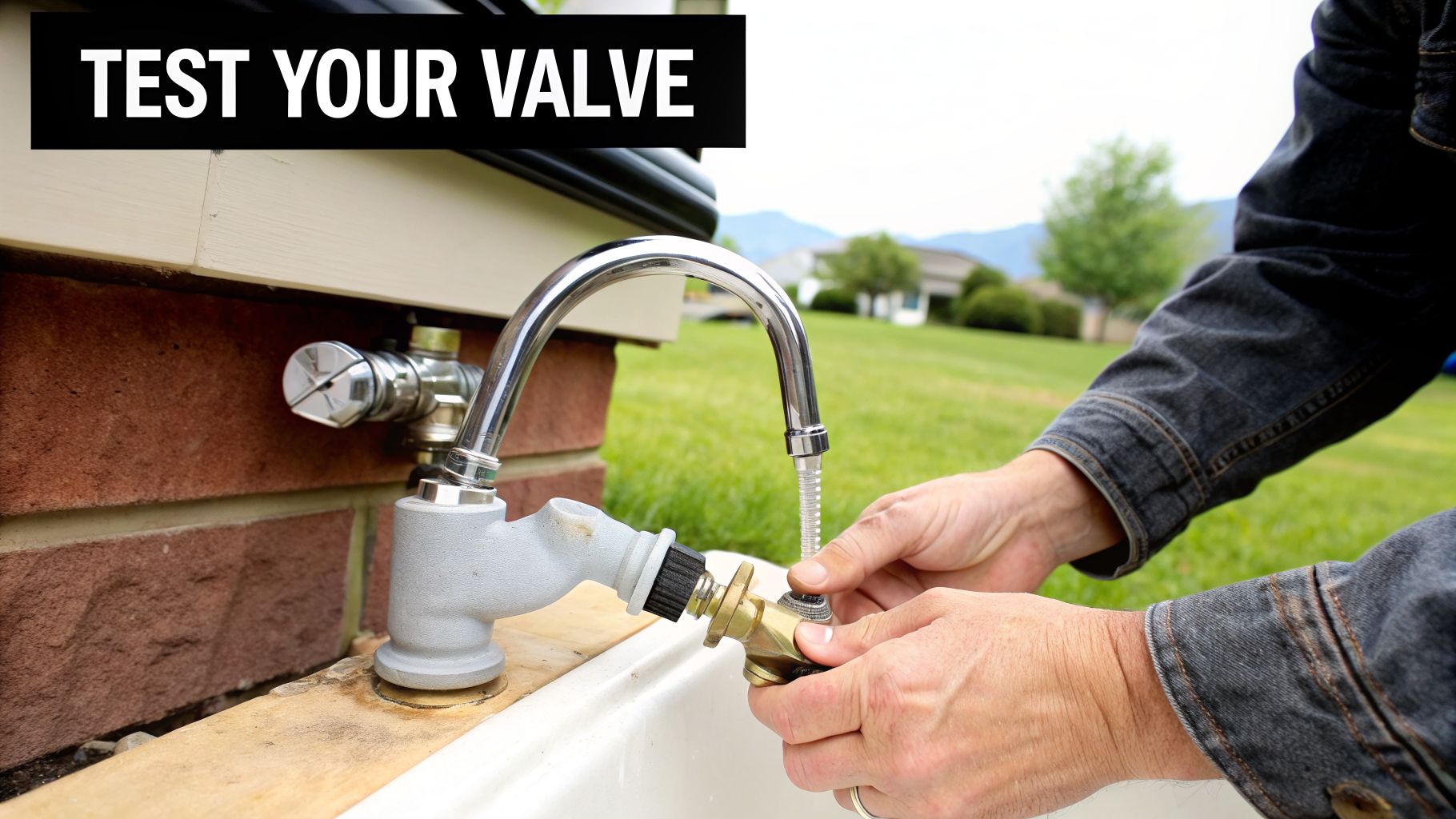
Think of it as a fire drill for your plumbing. A few minutes of testing once or twice a year can stop mineral buildup from freezing the mechanism, giving you peace of mind that your home’s first line of defence is in good working order.
The Gentle Test-and-Verify Procedure
Testing a shut off valve is straightforward, but the real key is to be gentle. Forcing a stubborn valve, particularly an older gate valve, can easily break the handle or stem. That's how you can accidentally create the very emergency you're trying to prevent.
Follow this simple, safe procedure:
- Gently Close the Valve: For a lever-style ball valve, make a slow quarter-turn until the handle sits perpendicular to the pipe. If you have a wheel-style gate valve, turn it clockwise slowly until you feel it stop. Don't crank it tight.
- Verify the Water Has Stopped: Head to the nearest fixture that the valve controls. If you're testing an angle stop under the sink, turn on that tap. For the main shut off, just turn on any tap in the house. After a few seconds, the water should stop completely.
- Slowly Reopen the Valve: Turn the valve back to its fully open position. Again, do this slowly. Reopening it too fast can cause a sudden pressure surge, known as a water hammer, which can put a lot of strain on your pipes.
This simple check-up, often called "exercising the valve," keeps its internal parts moving freely and stops them from seizing up over time.
What to Do If a Valve Is Stuck or Leaking
Sometimes, even when you're being careful, you’ll hit a snag. A valve might refuse to budge, or it might start dripping the moment you touch it. Knowing how to react is crucial.
If a Shut Off Valve is Seized
Never grab a wrench or use brute force to try and unstick a valve handle. This is especially true for those older, wheel-handled gate valves. You could easily snap the stem, leaving the valve permanently stuck and potentially causing a major leak.
Instead, you can try gently tapping the body of the valve with a small hammer to see if that loosens any mineral deposits inside. If it still won’t turn, that’s a clear sign the valve needs replacing.
A seized valve is a ticking time bomb. It has failed its one job. This isn't a DIY fix—it's time to call a professional from Ring Hot Water to replace it before a real emergency forces your hand.
If the Valve Starts Leaking
A small drip from around the handle's stem might be an easy fix. Try gently tightening the "packing nut" (it's the nut right below the handle) with a spanner. Usually, a simple one-eighth of a turn is all it needs. If the leak stops, you've solved it.
However, if the leak keeps going, gets worse, or is coming from the body of the valve itself, it means the internal seals have failed. This shut off valve is compromised and must be replaced. Shut off the water at the next valve upstream (usually your main water shut off) and call for professional help.
The integrity of these components is a serious business, a fact reflected in Australia's industrial valves market which was valued at USD 2.266 billion in 2024. You can find more insights on this critical market over at Data Bridge Market Research.
When to DIY and When to Call a Professional Plumber
There’s a real satisfaction in sorting out a small home repair yourself. But when it comes to your plumbing, especially something as vital as a shut off valve, knowing where to draw the line between a quick fix and a job for the pros is crucial. Get it wrong, and a tiny drip can quickly turn into a major, costly flood.
While tackling a job yourself is tempting, some plumbing tasks just aren't worth the risk. A simple mistake with a shut off valve can lead to a persistent leak that damages your floors and cupboards, or worse, a full-blown emergency. Before you even think about picking up a wrench, you need to be honest about the job and your own skill level.
Scenarios Fit for a Confident DIYer
Some shut off valve jobs are definitely within reach for a homeowner with the right tools and a bit of confidence. These are typically low-risk tasks where a mistake is more of an annoyance than a catastrophe.
A perfect example is replacing an angle stop—that’s the small valve under your kitchen sink or behind the toilet. If you can get to it easily, it uses a simple compression or screw-on fitting (not soldered), and you’re 100% sure you can shut off the main water supply first, it's a very manageable project.
- Fixing a Dripping Handle: If you've got a slow drip from the handle’s packing nut and a gentle tighten doesn’t stop it, swapping out the whole valve is often the best next step.
- Upgrading for a New Fixture: Putting in a new dishwasher or a fancy bidet toilet seat? It’s a great time to replace that old, stiff valve with a modern, reliable quarter-turn ball valve.
Even with these simpler tasks, preparation is everything. Make sure you have the exact replacement valve, all the right tools, and a clear plan before you shut the water off. Nothing’s worse than being stuck mid-job without a crucial part.
Unmistakable Signs to Call a Professional
Then there are the red flags. These are the clear-cut signs that you need to put the tools down and call in an expert. Trying to tackle these issues on your own is a huge gamble with your property.
If you had a burst pipe, your first move would be finding a professional plumber fast. You should have the same sense of urgency for these valve problems.
Call a Professional Plumber Immediately If:
The Main Water Shut Off Valve is Seized or Leaking: This valve is the master switch for your entire home’s water supply. If it’s stuck solid, dripping, or looks heavily corroded, don’t try to force it. Breaking this valve could leave you with an unstoppable torrent of water flooding your home.
Any Valve is Soldered in Place: If you see a valve connected to copper pipes with a melted-on, metallic joint, it's been soldered. Replacing it requires a blowtorch and a plumber's expertise. It's absolutely not a DIY job—you could damage the pipe or create a leak that won’t show itself until it’s too late.
You See Visible Corrosion or Damage: That crusty green or white build-up on the valve body is a major warning sign. If you see that, or any cracks, the valve is on its last legs. Simply trying to turn it could cause it to break apart in your hand.
The Valve is in a Hard-to-Reach Spot: Is the valve buried behind a wall, wedged in a tiny crawlspace, or otherwise a nightmare to get to? A professional has the specific tools and experience to work in those tight spots safely and effectively.
For any of these complex or high-stakes jobs, the skill of a licensed plumber isn't a luxury—it's essential. If you're up against a failing valve or just aren't sure, it's always smartest to schedule a service call with the Ring Hot Water team and have peace of mind that it’s done right.
Frequently Asked Questions About Shut Off Valves
Even after you’ve got a handle on the basics of your plumbing, a few practical questions always seem to pop up. Let's run through some of the most common queries we hear from homeowners, helping you build on what you know and handle those real-world situations with confidence.
How Often Should I Test My Shut Off Valves?
Think of it as a quick health check for your home’s plumbing. We recommend giving your main water shut off and the individual valves under sinks and behind appliances a quick test at least once a year.
It’s a simple exercise: just turn the handle or knob all the way to the off position, then open it back up again. This simple twist prevents the valve from seizing up with mineral deposits and gives you peace of mind that it will actually work when you need it most.
What Should I Do If My Shut Off Valve Is Leaking?
A small, steady drip from the valve stem—that's the little pin right under the handle—can sometimes be an easy fix. Try giving the packing nut a gentle tweak with a spanner; often, just a one-eighth turn is all it takes to stop the drip.
If that doesn't solve it, or if the leak is coming from the main body of the valve, you’ve got a clear sign it's failing. At this point, you'll want to shut off the water at the main supply and call in a professional plumber to get that faulty valve replaced before a small drip becomes a big problem.
A leaking shut off valve is more than an annoyance; it’s a warning. Ignoring it can lead to significant water damage. Address it quickly to protect your property.
Can I Replace a Shut Off Valve Myself?
For those with a bit of previous plumbing experience, replacing a simple angle stop valve under a sink can be a manageable DIY job. These often use compression fittings, which don't require any soldering and are fairly straightforward to install.
However, when it comes to any valve that's soldered into the pipework, or especially the main water shut off valve, this is a job that should always be left to a licensed plumber. An improper installation here can lead to major leaks and serious property damage, making it a risk that just isn't worth taking.
Why Won't My Old Gate Valve Turn?
Those old, wheel-handled gate valves are notorious for seizing up over the years. Corrosion and mineral scale build up on the internal stem, effectively freezing it in place.
It's absolutely critical that you never use excessive force or a big wrench to try and crank it open or closed. You can easily snap the handle or the internal stem, which could leave you with a leak that you can’t stop. If a gate valve won't budge, take it as a clear sign that it’s at the end of its life and needs replacing—preferably before an emergency forces your hand.
Whether you're looking for a hard-to-find part or just need some expert advice on a tricky plumbing job, Ring Hot Water has you covered. Explore our range of genuine shut off valves, fittings, and more to get your project done right. Find everything you need at https://ringhotwater.com.au.
