Uncategorized
Water Heater Repair Melbourne: Your 2026 Expert Guide
Jul
You turn on the kitchen tap before work, expecting the usual rush of hot water for dishes or a quick rinse, and instead get a weak trickle, lukewarm water, or nothing at all. In an office, it's the boiling tap that suddenly stops dispensing. In a café, the wall boiler starts hissing or dripping just as the morning rush begins. In a Melbourne winter, that kind of fault feels urgent fast.
That's where water heater repair gets confusing. Most advice online talks about central heating, ducted units, or big household systems. That's not what many Melbourne homes and workplaces rely on day to day. A lot of the problems happen in instant boiling taps, under-sink storage units, wall-mounted boilers, commercial urns, and compact hot water appliances.
This guide stays focused on those systems. It's written the way a technician would explain it at your sink or plant room door. Calmly, clearly, and with an eye on what's safe to check yourself, what usually causes the fault, and when it's time to stop troubleshooting and book proper heater repair.
Is Your Hot Water Heater Playing Up
A common call starts the same way. The unit was “fine yesterday”, then this morning the water isn't properly hot, the boiling tap is only warm, or the under-sink heater has gone completely quiet. Sometimes there's a puddle under the cupboard. Sometimes the tap splutters and spits air before settling into an uneven stream.
In Melbourne homes, that often happens with compact systems that people don't think much about until they stop. An instant boiling tap in the kitchen, a small electric storage heater under a sink, or a wall boiler in a staff kitchen can work reliably for years. Then one small component starts failing and the whole unit feels unpredictable.
What matters first is staying calm and narrowing the fault down. If the issue is limited to one fixture or one appliance, that points you in a different direction than a whole-property hot water failure. If you need to isolate the appliance safely, it helps to know where the hot water shut-off valve is before anyone starts poking around under the sink.
What usually worries people most
The worry isn't just the loss of hot water. It's the uncertainty.
- Is it dangerous: A small leak and an electrical appliance under a bench make people nervous, rightly so.
- Is it expensive: A minor thermostat fault feels very different from a failed tank or internal control board.
- Is it urgent: Some faults can wait for a booked service. Others shouldn't.
Practical rule: If you can smell gas, see active leaking near electrical parts, or hear sharp popping or arcing sounds, stop using the unit and call a licensed professional.
The good news is that many water heating faults give warning signs before full failure. If you catch them early, heater repair is usually simpler, cleaner, and less disruptive than waiting for a total breakdown.
Key Signs Your Water Heater Needs Repair
The clearest sign is simple. You open the hot tap and there's no hot water at all. But plenty of faults start more subtly than that, especially in modern under-sink and boiling water systems.
Temperature problems that don't stay consistent
A unit that still works, but not properly, is often the first clue. You might notice the water starts hot and then drops away. Or the boiling tap dispenses hot water that clearly isn't reaching its usual temperature.
That points to control issues, element problems, scale build-up, sensor faults, or a thermostat drifting out of range. In storage-style units, it can also mean the heater is reheating too slowly for demand.
Noises, drips, and visible moisture
Water heaters shouldn't demand attention. If they start making noise, there's usually a reason.
Listen for:
- Popping or banging: Often linked to sediment or scale heating and shifting inside the unit.
- Hissing: Can suggest escaping steam, pressure issues, or water contacting hot internal parts.
- Clicking that won't stop: Sometimes a relay or control component struggling to complete a cycle.
Then look around the appliance itself.
- Moisture under the cupboard: Even a small pool can signal a failed seal, loose connection, or internal leak.
- Dripping from the tap head: This may be a valve, seal, or pressure-related issue rather than the tap alone.
- Staining around fittings: Old seepage leaves marks before it becomes an obvious leak.
A leak rarely fixes itself. It usually starts small, then damages cabinetry, flooring, or nearby electrical parts.
Changes in water quality or flow
If the hot water looks discoloured, smells unusual, or tastes metallic, that can point to internal corrosion or component wear. With drinking water appliances, any change in taste or clarity deserves attention because the unit may need repair, servicing, or filtration work.
A sudden drop in hot-side pressure matters too. If cold water pressure is normal but hot water flow is weak, the restriction is often within the appliance, valve set, or outlet path. That's especially common in scaled or partially blocked systems.
When the symptom tells you it's urgent
Some signs mean “book it in soon”. Others mean “stop using it”.
Call promptly if you notice:
- Complete loss of hot water
- Active leaking
- Burning smell
- Repeated tripping of power
- Steam, excessive heat, or casing distortion
Those aren't nuisance faults. They're signs your heater repair has moved beyond simple inconvenience.
Common Faults in Different Water Heaters
Not all hot water systems fail the same way. A Zip-style boiling tap behaves differently from a small under-sink storage heater, and both differ again from a wall-mounted commercial boiler. The fastest way to understand a fault is to start with the type of unit you have.
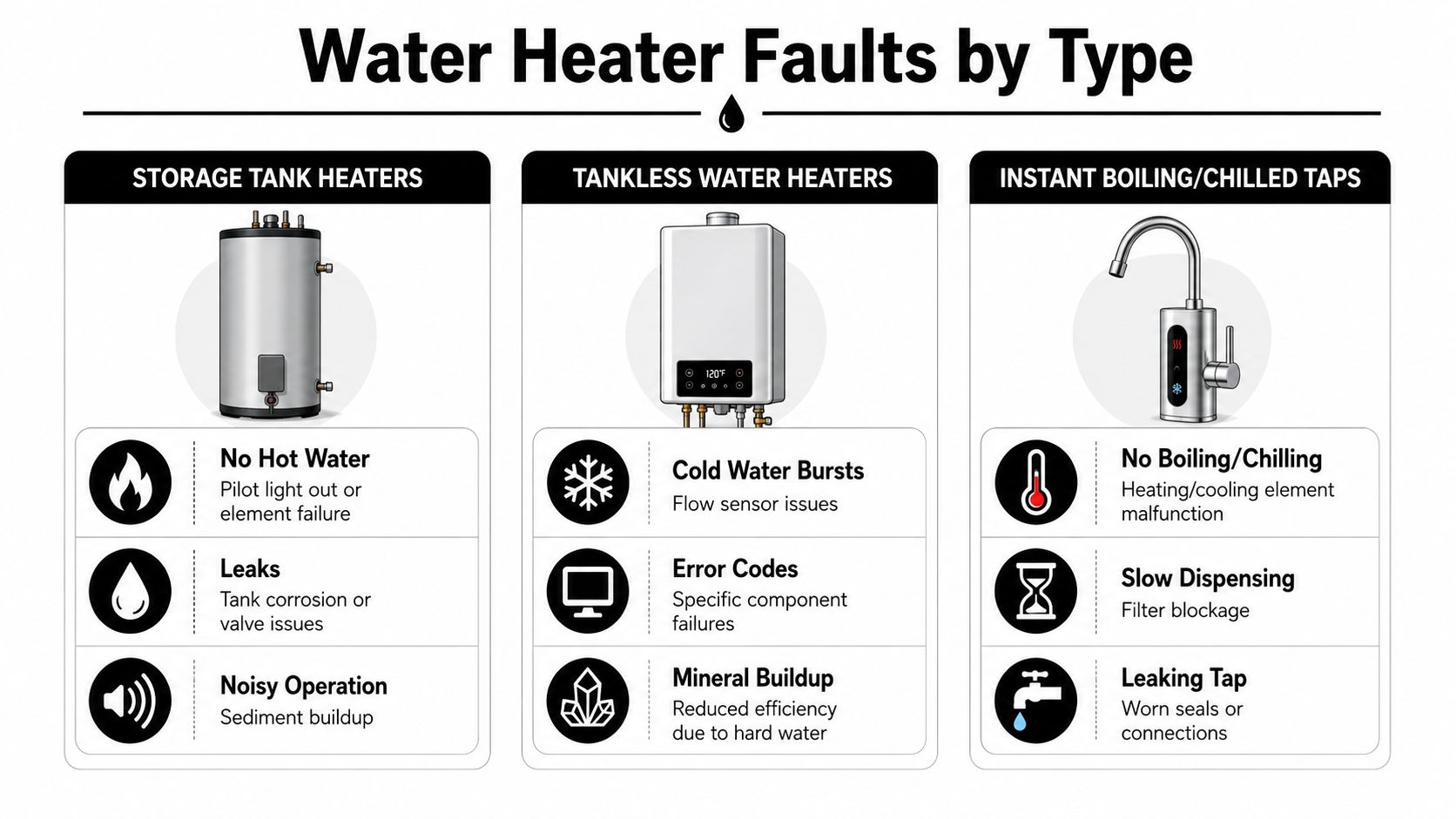
Instant boiling and chilled taps
These are common in renovated Melbourne kitchens, offices, and meeting rooms. Brands in this category often combine a compact under-bench command unit with a tap on the sink or benchtop.
Typical faults include:
- Boiling water that isn't boiling: Often linked to thermostat, sensor, or heating control issues.
- Slow dispensing: Sometimes a blocked filter, scaled outlet, or restricted inlet.
- Tap dribbling after use: Solenoid, seal, or pressure-control problems are common causes.
- Unit powers on but doesn't heat or chill properly: This can point to an internal component fault that needs proper testing.
These systems are convenient, but they're not forgiving of guesswork. Opening the wrong panel or swapping parts blindly can create a bigger repair.
Under-sink electric storage heaters
Small storage units are widely used in kitchens, offices, and point-of-use applications. They look simple, but the same few failures come up again and again.
Common problems are:
| Unit type | Fault pattern | What it often means |
|---|---|---|
| Under-sink storage heater | Water stays cold | Failed element, thermostat issue, tripped cut-out |
| Under-sink storage heater | Rust-coloured water | Internal corrosion or tank wear |
| Under-sink storage heater | Leaking from base | Tank deterioration or failed fitting |
| Under-sink storage heater | Runs hot then cold quickly | Limited stored volume, poor recovery, or heating fault |
Storage heaters also depend on good corrosion protection over time. If that protection has been neglected, the repair decision changes quickly from “replace a part” to “replace the unit”.
Wall-mounted boilers and commercial urns
These units show up in tea rooms, schools, hospitality spaces, site sheds, and shared kitchens. They're built for repeated use, but constant heating cycles and water quality issues take a toll.
You'll often see:
- Scale build-up inside the vessel or outlet path
- Thermostat failure causing overheating or underheating
- Leaking taps and worn seals
- Poor refill behaviour or erratic shut-off
- Element stress after long service intervals
Commercial units usually fail in a more visible way. They drip, slow down, overheat, or stop recovering between uses.
Why system type matters before any repair
In Victoria's commercial and industrial heat pump water heater systems, the Victorian technical guidelines state that performance has to be assessed across the whole system, not just the heat pump unit, and improper thermal storage sizing can reduce system COP by 15–25%. That's a useful reminder even outside heat pumps. Water heating faults rarely come from one isolated part alone. The appliance, storage, controls, fittings, and usage pattern all affect how the system behaves.
For heater repair, that means a good diagnosis starts with the full setup. Not just the brand badge on the front.
Safe DIY Troubleshooting You Can Try First
You can do a few checks yourself before booking heater repair. The key word is safe. You're checking settings, supply, and obvious external issues. You're not opening live electrical compartments, pulling apart sealed units, or touching gas components.
Start by switching the unit off at the local isolator or circuit breaker if you're inspecting closely around it.
The first checks worth doing
Many call-outs end up being something simple. A tripped breaker. A switched-off powerpoint under the sink. A resettable safety cut-out that's done its job.
Use this quick checklist:
| Check | Action | Notes |
|---|---|---|
| Power supply | Confirm the unit is switched on and the breaker hasn't tripped | Don't repeatedly reset a breaker that keeps tripping |
| External controls | Check the thermostat or temperature setting | Settings can be changed accidentally during cleaning or storage |
| Reset function | Look for a manufacturer reset button if your model has one | Press once only, then monitor |
| Visible leaks | Inspect hoses, valves, and the base of the unit | Active leaking means stop using the appliance |
| Pipe insulation | Check exposed hot pipework for intact insulation | Missing or damaged insulation affects heat retention |
If you're dealing with an electric storage unit and want to understand one common failure point before calling a technician, this guide on how to test a hot water element helps explain the part's role. Leave live testing and replacement to a licensed professional.
Don't ignore insulation around the unit
Insulation sounds minor until you see what poor insulation does to performance. According to AS/NZS 3500.4 guidance referenced here, hot water pipes, fittings, and valves should be insulated, and failure to keep that insulation continuous can reduce thermal retention by up to 18% while increasing energy consumption by 5–10% per degree of higher thermostat setting in Melbourne's temperate climate.
That matters because people often respond to weak hot water by turning the thermostat up. If the issue is heat loss from poor insulation, that doesn't solve the root problem.
What not to do: Don't remove the main casing, bypass a safety device, tamper with internal wiring, or touch any gas component. That isn't careful DIY. That's how small faults turn unsafe.
When DIY stops being sensible
Stop troubleshooting and book service if:
- The unit trips power again after reset
- You can see water inside electrical areas
- The casing is unusually hot
- The leak is coming from the tank body
- The appliance shows persistent fault behaviour after the basic checks
The goal of a safe check is to rule out the obvious. It isn't to become the repairer.
Estimating Heater Repair Costs and Time in Melbourne
You usually find out there is a problem at the worst time. The boiling tap stops heating before the school run, the under-sink unit starts dripping into the cupboard, or the wall boiler gives you hot water one minute and lukewarm water the next. At that point, most Melbourne homeowners want two answers fast. What is this likely to cost, and how long am I going to be without reliable hot water?
The honest answer is that repair pricing depends less on the label on the unit and more on what has failed, how accessible the appliance is, and whether parts are available that day. On modern systems such as instant boiling taps, compact under-sink heaters, and wall-mounted boilers, the job often includes diagnosis first, then the repair itself. That is why one callout ends with a same-visit fix, while another needs a return visit once the exact part is confirmed.
In practice, the final bill usually has three parts: callout, labour, and parts.
Simple jobs sit at the lower end of the range because the fault is obvious and the replacement part is common. More involved jobs take longer because the technician may need to isolate power and water, remove covers, test multiple components, and confirm whether one failed part has caused stress elsewhere in the system.
A few examples make the difference clearer:
- Lower-complexity repairs often include a reset, an accessible thermostat replacement, a straightforward valve swap, or a loose connection that can be corrected without dismantling half the unit.
- Mid-range repairs can involve failed sensors, faulty inlet valves, worn tap components, minor leaks inside an under-sink command centre, or electrical parts that need proper testing before replacement.
- Higher-cost repairs are usually the ones involving brand-specific control boards, concealed leaks, hard-to-access installations, repeat fault tracing, or specialised boiling water systems with filtration and electronic controls working together.
Access matters more than many people expect. A unit installed neatly in an open service area is quicker to work on than one packed into a tight cabinet behind stored cleaning products and pipework. The same fault can take very different labour time depending on how easy it is to reach safely.
Brand and model matter too. A standard storage heater part is often easier to source than a component for a premium zip-style boiling tap or a compact imported under-sink unit. That does not always mean the specialised system is a bad choice. It means repair planning needs to allow for exact parts, especially in Melbourne homes and offices using newer hot water setups rather than conventional whole-home heating equipment. If you are comparing broader heating repair advice online, keep in mind that furnace and central heating articles often do not reflect how these local water heating appliances are diagnosed and repaired.
Timeframes follow the same pattern. Many straightforward repairs can be completed in one visit if the fault is common and the technician carries the part in the van. A specialised appliance may need a second visit when the diagnosis is clear but the manufacturer-specific part has to be ordered. That is common with advanced boiling tap systems and some wall boilers.
Delaying the repair can push the cost up. A small leak under a sink can damage the cabinet base. An overheating unit can trip repeatedly and stress other components. A heater that struggles to hold temperature often gets adjusted higher by the user, which masks the underlying fault and can shorten the life of the system.
The practical question is not just "what will this repair cost today?" It is also "what happens if I leave it for another week?" In many cases, early repair is the cheaper decision.
Hiring a Professional Heater Repair Service in Melbourne
Once the problem moves beyond the safe checks, a licensed technician is the right next step. That isn't just about convenience. It's about safety, warranty issues, compliance, and avoiding misdiagnosis.
Know what counts as urgent
A complete lack of hot water in an Australian rental context is commonly treated as an urgent repair, with expected landlord response within 24–48 hours, while partial faults or general heater issues don't always qualify the same way, as discussed in this Australian rental repair discussion. For owners as well as renters, that distinction matters. It helps you decide whether to request immediate attendance or book the next available service window.
Gas work sits in a stricter category again. If the unit involves gas and there's any concern about smell, combustion, burner behaviour, or internal gas components, only a licensed gasfitter should touch it.
What to look for in a repair service
Not every plumber or general HVAC technician works regularly on boiling taps, under-sink command centres, or wall boilers. Specialised appliances reward specialised experience.
Look for a service that can clearly handle:
- Your specific appliance type
- Your brand and model range
- Electrical and water-side diagnosis
- Parts sourcing for compact and commercial units
- Safe isolation and recommissioning
The broader Australian Air-Conditioning & Heating Services industry is projected to include 7,383 businesses with a market size of $13.1 billion in 2026, and IBISWorld notes a 1.0% CAGR between 2020 and 2025 for the sector, while also pointing to a skills shortage in service and maintenance that can affect response times for repairs across Australia, including Melbourne, according to IBISWorld's industry outlook. That's one reason it's smart to book non-urgent work before winter pressure builds.
For readers comparing broader home heating services outside the specialised water-heating space, this overview of heating repair gives a useful look at how technicians approach fault symptoms and service decisions in conventional heating systems.
Your rights if a repair goes wrong
If a business repairs a faulty product or service and the result isn't adequate, you're not stuck accepting it. The ACCC's repair, replace, refund problem solver explains consumer rights around remedies for faulty goods and services.
That matters with water heaters because people sometimes pay for one repair, only to find the original issue hasn't been properly resolved. A professional should be able to explain what failed, what was replaced, and whether the repair addresses the root cause or only the visible symptom.
Good heater repair isn't just replacing a part. It's proving why that part failed and checking whether anything else in the system caused it.
Preventative Maintenance to Avoid Future Repairs
A lot of Melbourne call-outs start the same way. The boiling tap has been dripping for weeks, the cupboard under the sink feels warm, or the wall boiler has started making a different noise and nobody has had time to check it. Then one busy morning, the unit locks out or stops heating properly.
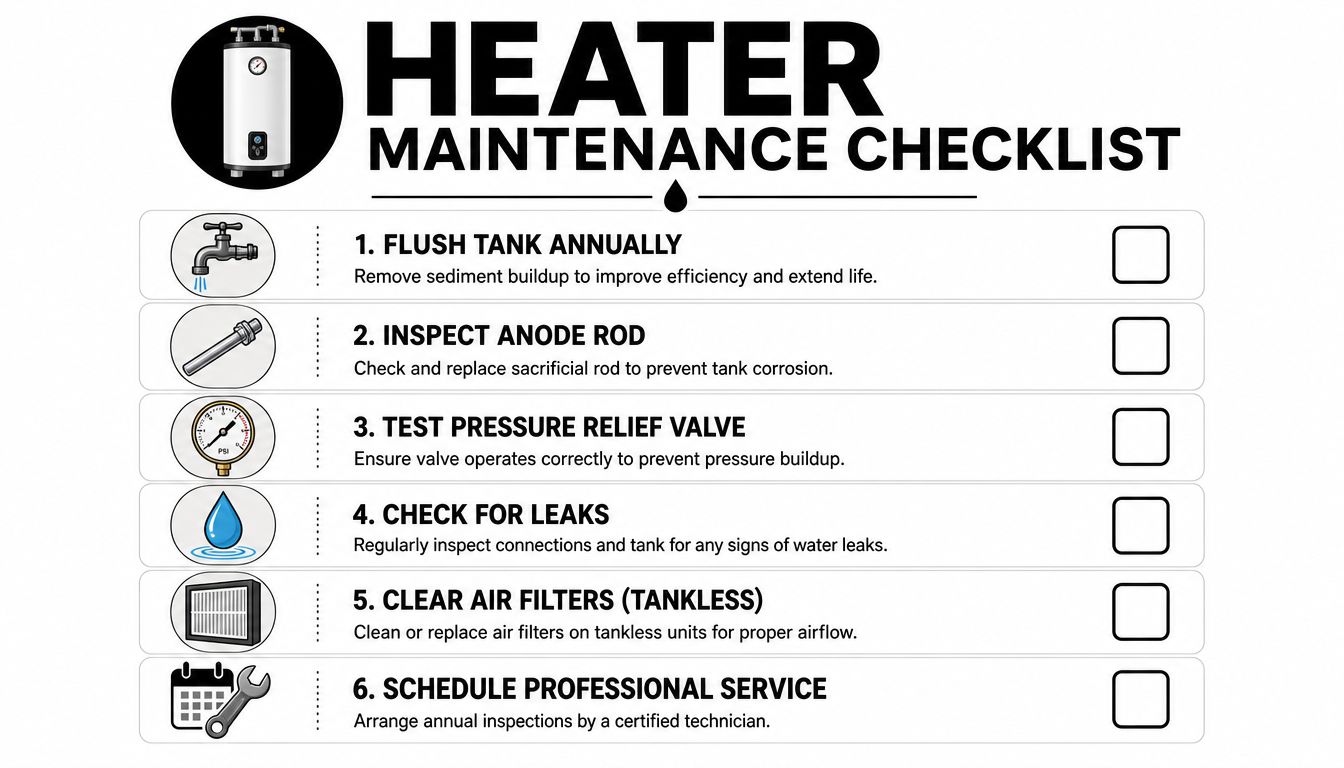
Modern water heating systems usually give some warning before they fail. Instant boiling taps, under-sink units, and compact wall boilers are reliable, but they are less forgiving if scale builds up, pressure runs high, or small consumable parts are left too long. A simple maintenance routine costs far less than an urgent repair, especially if the unit is installed in a café, office kitchen, medical fit-out, or a busy family home.
A maintenance routine that actually helps
Start with what you can see and hear during normal use. A quick check once a month is often enough to catch the early signs.
- Look for small leaks: Check under sinks, around inlet and relief valves, and at the base of the unit. Even minor weeping can point to pressure problems, worn seals, or corrosion starting.
- Watch for scale build-up: Melbourne water conditions vary by suburb, and some systems collect mineral build-up faster than others. Boiling taps and under-sink heaters can lose performance gradually before owners notice.
- Test safety functions during scheduled service: Relief valves, thermostats, over-temp cut-outs, and control assemblies need to operate properly. These are not parts to ignore or bypass.
- Replace service items on time: Filters, seals, anodes, and cartridges wear out. Delaying replacement often turns a small service job into a larger repair.
- Check pressure control components: If your unit includes one, this guide to the pressure limiting valve explains why excessive supply pressure can lead to dripping, noisy operation, and shorter component life.
Commercial sites should be stricter about this than households. Equipment that cycles all day will show wear sooner, even if it still seems to be working normally.
For organisations that want a broader maintenance mindset, this guide on how to eliminate unplanned HVAC downtime is a practical reminder that scheduled servicing beats reactive breakdowns every time.
Here's a useful visual summary to keep in mind:
The long-term payoff
As noted earlier, government guidance supports regular servicing before heavy seasonal use. That principle applies well to water heaters in Melbourne. Book maintenance before winter demand, not once the system has already started tripping, leaking, or slowing down.
Good maintenance is not just about efficiency. It protects safety controls, helps keep water temperature stable, and gives a technician the chance to spot heat stress, loose wiring, failing valves, and early corrosion before those faults become disruptive.
A maintained unit is easier to trust. It heats more predictably, wastes less time and energy, and gives you a much better chance of avoiding the morning when the hot water suddenly drops out.
If your boiling tap, under-sink heater, wall boiler, urn, or compact hot water unit is playing up, Ring Hot Water can help with specialist advice, genuine parts, and Melbourne-based repair and maintenance support for modern water heating systems.

