Uncategorized
What Is the Most Energy Efficient Hot Water Tap for an Australian Home
Jun
Most advice on the most energy efficient hot water tap for an Australian home gets one thing wrong. It treats the answer like a product label, when it's really a usage question.
A tap can look efficient on a spec sheet and still be the wrong choice in a real kitchen. If your household makes a few cups of tea each day, a compact system may suit you. If people are drawing hot water all day, the balance shifts. And if the tap only reaches 95°C when you expected a true boil, that matters more than most buyer guides admit.
The old comparison is usually tap versus kettle. That's too simple. The more useful comparison is this: what temperature do you need, how often do you need it, and what kind of unit is sitting under the sink doing the work?
The Search for Australia's Most Efficient Hot Water Tap
The honest answer isn't a single brand or model. It's that the most efficient tap depends on how your household uses hot water, not just what the brochure says.
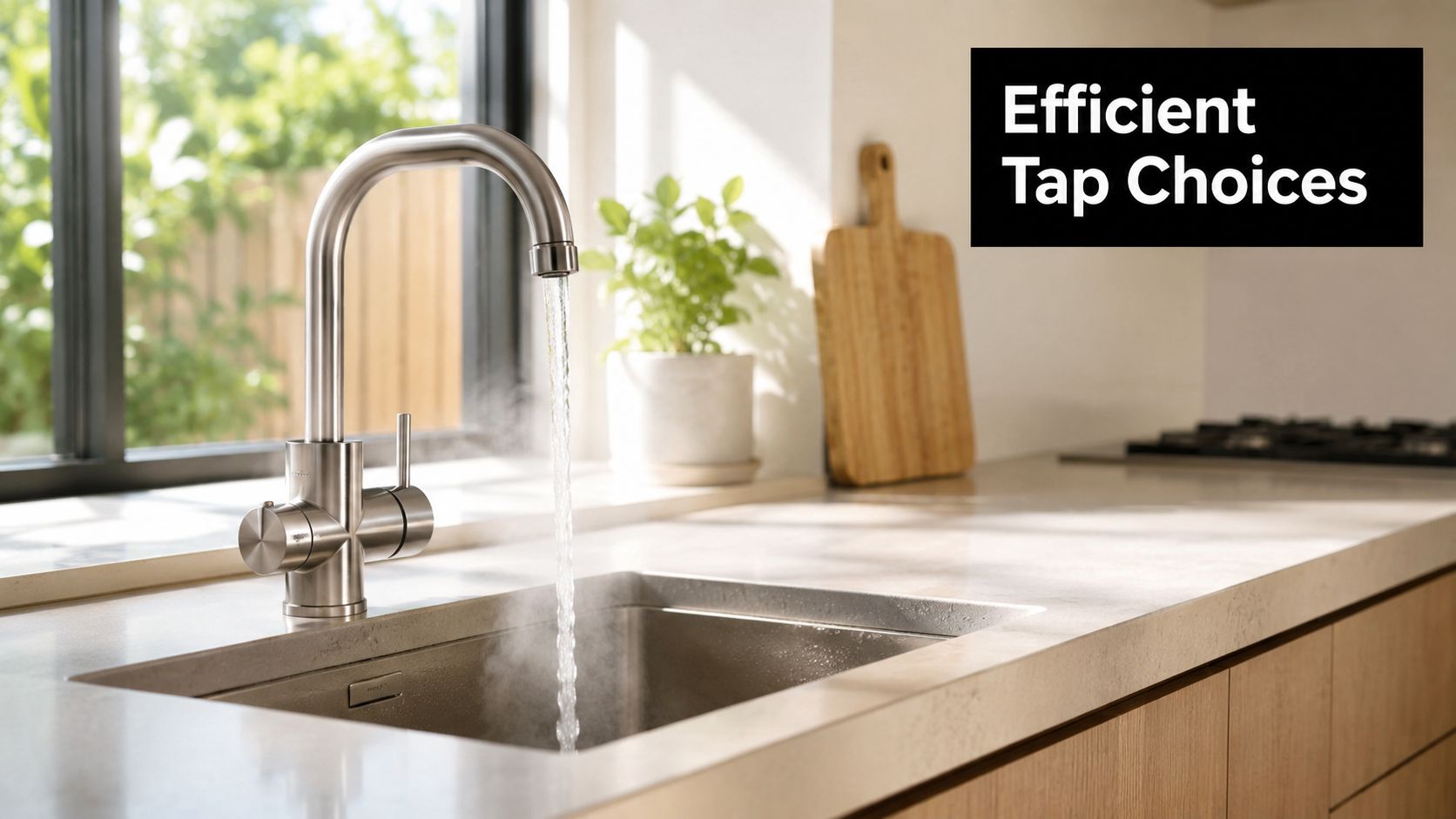
A lot of homeowners ask for “the most efficient hot water tap” when they really mean one of three different things. They might mean the cheapest to run, the fastest for drinks, or the best fit for replacing repeated kettle use. Those aren't always the same answer.
Why the usual advice misses the point
The biggest mistake is assuming all “instant hot water taps” do the same job. They don't. Some are designed to hold near-boiling water ready to go. Some heat on demand. Some store a small amount of hot water and top it up as needed.
Then there's the temperature issue. A tap that delivers very hot water can be practical for washing up or some kitchen tasks, but if you want true boiling performance for tea or cooking, a lower delivery temperature changes the result.
Practical rule: Don't judge efficiency by the word “hot”. Judge it by the temperature you actually need and how often you draw it.
Start with your own habits
Before comparing units, ask yourself a few blunt questions:
- How often do you use hot water at the sink? Once or twice a day is very different from constant use.
- What do you use it for? Tea, coffee, instant meals, blanching vegetables, filling pots, or just warm rinsing all place different demands on the system.
- Do you want true boiling water or just very hot water? That last few degrees can change both convenience and efficiency.
- Is bench space a problem? Many people choose an integrated tap because they want to get rid of the kettle as much as they want to save energy.
A good decision starts there. Once you know your pattern, the trade-offs become much clearer.
Understanding Your Hot Water Tap Options
Under most Australian sinks, these systems fall into three broad groups. They all solve the same problem differently, and that's why their energy behaviour varies so much.
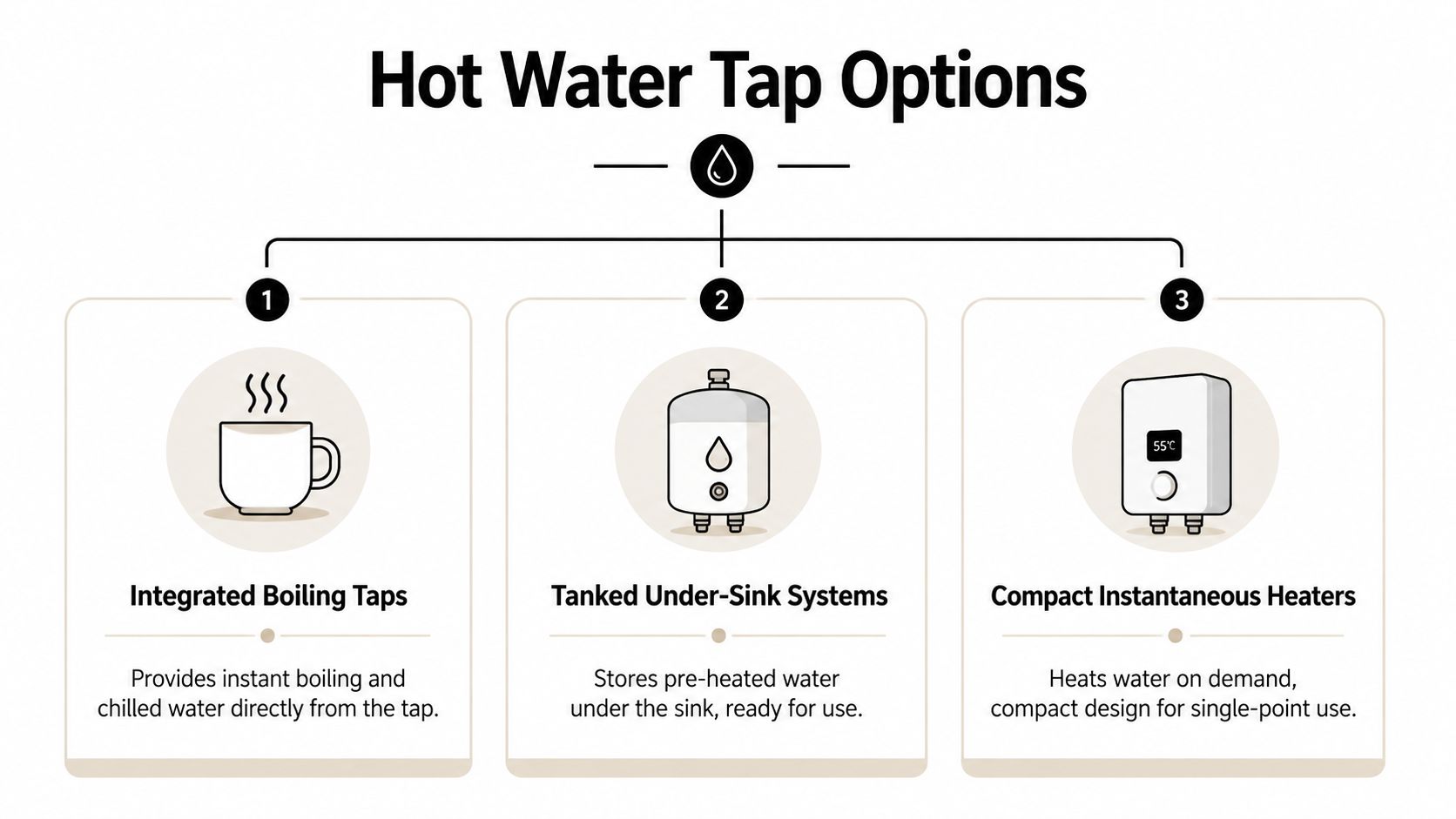
Integrated boiling tap systems
These are the units often envisioned first. Brands in this category usually combine a special tap with an under-sink tank that keeps water ready at high temperature. Think of them like a well-insulated thermos with a heating element. The system stores hot water, then tops up heat as needed.
That design has one obvious benefit. You don't wait around for the water to heat every time. You turn the handle or press the control, and the water is there.
The energy question comes down to draw pattern. In Australian homes, the efficiency of an instant boiling water tap compared to a kettle depends on usage, but under high-frequency, spread-out demand, boiling water taps can use up to 50% less energy than traditional kettles because kettles usually draw 2 to 3 kilowatts while heating, are often overfilled, and are repeatedly reboiled, while a boiling water tap has a standby draw of only around 10 watts and avoids much of that waste, according to this analysis of boiling taps versus kettles in Australia.
That's why these systems tend to make more sense in busy kitchens than in homes where someone only boils water occasionally.
If you're looking at this category in more detail, a guide to instant hot water tap options for Australian homes is useful for understanding the common layouts and configurations.
Compact instantaneous heaters
These work differently. They don't keep a tank sitting hot under the sink. They heat water as it passes through the unit. The simple analogy is a toaster versus a thermos. Nothing is held ready. Heat is created only when you ask for it.
That can be attractive where use is infrequent or where the point of use is very specific, such as a small kitchenette or a separate sink. The trade-off is flow and output. If you expect the same feel as a dedicated boiling unit, you may be disappointed.
Here the installation detail matters as much as the appliance. Pipe run, electrical capacity, and intended use all affect real performance. If you're comparing broader system choices or planning a related hot water system installation, it helps to look at the whole plumbing and electrical setup rather than the tap in isolation.
Small vented storage heaters
These are the quiet achievers of the category. A small tank sits under the sink and stores heated water for local use. They're straightforward, proven, and often practical where you want a basic point-of-use supply.
Their strength is simplicity. Their weakness is also simplicity. If insulation is average and the unit sits there maintaining temperature for long periods with little use, the energy story can flatten out quickly.
Later, the best choice usually comes down to one question: are you paying more for standby than you're saving in convenience?
For a quick visual summary of how these systems differ, this short video is a handy primer.
The Real Factors That Determine Energy Efficiency
The spec sheet only tells part of the story. Real efficiency comes from the combination of standby loss, target temperature, insulation quality, and user behaviour.
Standby power is small but constant
Standby power is the energy a unit uses while waiting for the next draw. The easiest way to think about it is like a phone charger left in the wall. One charger isn't dramatic, but a device that sips power all day, every day, needs to justify that ongoing draw by saving energy elsewhere.
That's why a boiling tap can be brilliant in one household and wasteful in another. In a busy kitchen, the standing heat is being used regularly. In a quiet household, the system may spend more time maintaining temperature than delivering useful water.
A hot water tap is efficient when its waiting time matches your usage. If it spends most of the day on standby for one or two cups, you're buying convenience first and efficiency second.
The 95°C versus 100°C distinction matters
This is the issue most buyers never get told clearly enough. A lot of content lumps “hot”, “near-boiling”, and “boiling” into one bucket. That blurs a very practical difference.
According to STIEBEL ELTRON's discussion of boiling water units in Australia, many taps deliver up to 95°C water, and existing content often fails to separate those systems from true boiling solutions. The same source notes that households typically use boiling water for tea or cooking, and highlights that the HOT 2.6 N Premium delivers water up to 95°C with polyurethane foam insulation designed to minimise standby losses.
A 95°C tap may reduce standby loss because it isn't maintaining full boil. On paper, that can look attractive. In practice, if you regularly need true boiling water, the energy saved at rest may be offset by extra reheating elsewhere, or by the simple frustration of not getting the result you expected.
Don't ignore insulation and certification
Two units with similar temperatures can perform very differently if one has better insulation around the tank and pipework. Better insulation means less heat escapes into the cupboard, which means the element cycles less often.
When I assess these systems, I also look for the boring things buyers often skip:
- Tank insulation quality so the cupboard doesn't become a warm box
- Tap body design so the outlet and handle stay safe to use
- WaterMark certification for Australian compliance
- Service access because a unit that's hard to maintain often gets neglected
If you're trying to boost your home's energy savings, this is a good example of how small hardware decisions affect long-term performance. It's rarely one silver bullet. It's many small losses removed one by one.
Comparing the Contenders A Side by Side Look
A side-by-side view makes the trade-offs easier to judge. Not every feature can be reduced to a number, so the table below focuses on practical decision points rather than invented performance claims.
Hot Water Tap Technology Comparison
| Feature | Instant Boiling Tap System | Tankless On-Demand Heater | Small Vented Storage Heater |
|---|---|---|---|
| Primary method | Stores high-temperature water under the sink for immediate delivery | Heats water as it flows through the unit | Stores a small volume of heated water ready for use |
| Best fit | Busy kitchens, frequent drinks, repeated daytime use | Light or intermittent use at a single point | Simple point-of-use setups with modest demand |
| Standby behaviour | Has standby draw because the unit maintains temperature | Very low standby compared with stored-hot-water systems | Has standby draw while maintaining stored heat |
| Speed at outlet | Immediate for the stored volume | Depends on unit output and flow conditions | Immediate until stored volume is used |
| Temperature expectation | Best where users specifically want near-boiling or boiling-style convenience | Better for “hot when needed” than true boiling tap experience | Suits general hot water duties more than premium boiling tap convenience |
| Performance in high-use settings | Strong, because repeated draws make stored heat worthwhile | Can feel limited if many users want quick consecutive draws | Can run out of ready hot water during clustered use |
| Performance in low-use homes | Convenience may outweigh efficiency | Often makes more sense than holding water hot all day | Acceptable, but standby loss needs watching |
| Under-sink space needed | Moderate due to tank and associated hardware | Usually compact | Moderate due to storage vessel |
| Complexity | More integrated components, often premium tapware | Mechanically simple concept but output must match demand | Traditional and straightforward |
| Good buyer mindset | “We use this constantly and want kettle-free convenience” | “We use it occasionally and don't want stored hot water” | “We want a basic local hot water source with familiar operation” |
What usually works best
If your kitchen behaves like a mini office kitchen, an instant boiling system is often the strongest fit. If use is patchy, on-demand heating deserves a hard look. Small vented storage heaters sit in the middle. They're practical, but they rarely feel as effortless as a premium boiling tap.
For buyers comparing lower-draw options, this overview of a low power boiling water unit for home use is worth reading because it helps frame the trade-off between convenience and ongoing standby energy.
Bottom line: Match the technology to the rhythm of the kitchen. Constant use rewards stored-ready systems. Occasional use rewards systems that wait until you actually open the tap.
Calculating Your Running Costs With Real World Examples
The cheapest hot water tap on paper can be the wrong unit in a real kitchen. Running cost depends less on brochure claims and more on how often you draw water, what temperature you need, and whether the unit spends its day heating water no one uses.
Start with the temperature question, because many buyers blur two very different products together. A tap set to about 95°C is hot enough for tea, coffee, and most kitchen jobs, but it is not true boiling water at 100°C. That gap sounds minor. In practice, it affects tank temperature, standby loss, and whether the extra heat is doing useful work or just leaking into the cupboard under your sink.
Usage pattern decides whether that trade-off pays off. Standby power works like a phone charger left plugged in all day. One charger is small, but over time the idle draw adds up. A stored near-boiling or boiling system makes sense when the household keeps using it. If the kitchen goes quiet for long stretches, that stored heat can become wasted spend.
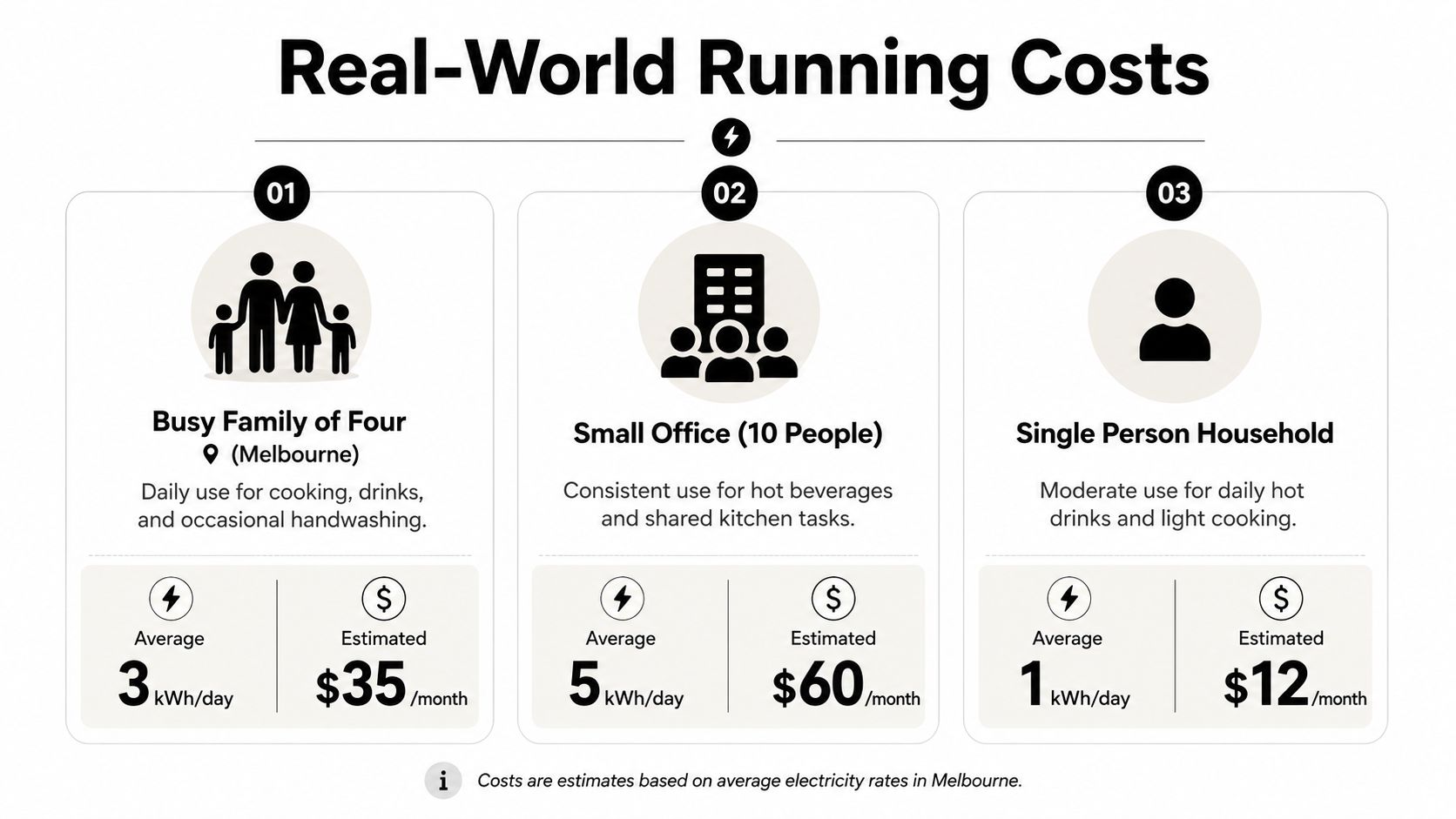
Three common Melbourne-style scenarios
Busy family kitchen
This is the home with constant short draws through the day. Mugs, porridge, noodles, blanching vegetables, warm-up water for cleaning. In that setting, a stored hot water tap often stacks up well because the unit is not just holding temperature. It is serving frequent demand.
The detail that matters is whether the household really needs 100°C or whether 95°C covers almost everything. If the answer is tea, coffee, and general prep, a lower setpoint can trim losses without changing the way the kitchen works.
Small office kitchenette
Shared kitchens often waste more energy through behaviour than through appliance design. Staff overfill kettles, reboil water, and leave half of it unused. That is where a well-matched boiling tap can earn its keep. The pattern is spread across the whole day, so stored heat gets used instead of sitting idle.
For a closer look at that comparison, see this guide to whether a boiling water tap is more energy efficient than a kettle in Australia.
Single-person apartment
I frequently observe buyers overspending. One or two drinks in the morning, maybe one more at night, rarely justifies keeping a tank near boiling all day. In that home, an on-demand unit or even a standard kettle can be the lower-cost answer.
Convenience still has value. It just should not be confused with efficiency.
Put the tap in the context of the whole house
A kitchen hot water tap only solves a point-of-use job. It does not carry the main hot water load for showers, laundry, and the rest of the house.
For whole-home hot water in Australia, the bigger savings usually come from the primary system. The ACT Government notes in its guidance on energy-efficient hot water systems that heat pumps use substantially less energy than standard electric storage or gas systems.
That matters because some homeowners expect a premium boiling tap to shift the household energy bill in a major way. Usually, it will not. It can be an efficient kitchen appliance in the right usage pattern, but the heavy lifting still happens at the main hot water system.
A practical way to estimate your own cost
Use your actual routine, not an idealised one:
- Count draws, not just litres. Ten short uses across a day suits stored-ready systems better than two clustered uses.
- Write down the timing. A tap used from breakfast to late evening spreads standby cost across more useful output.
- Be honest about temperature. If you rarely need true boiling water, paying to hold 100°C may not make sense when 95°C would do the job.
- Check for idle hours. Long quiet periods make standby losses more noticeable.
- Separate convenience from savings. Faster access, less bench clutter, and no kettle are valid reasons to buy. They are different from lower running costs.
- Look at the main hot water system as well. The largest savings in the home often come from the system serving bathrooms and laundry, not the tap at the sink.
Essential Features to Prioritise When Choosing Your Tap
Once you've narrowed the technology, the buying decision comes down to details that affect safety, serviceability, and daily use.
Features that matter every day
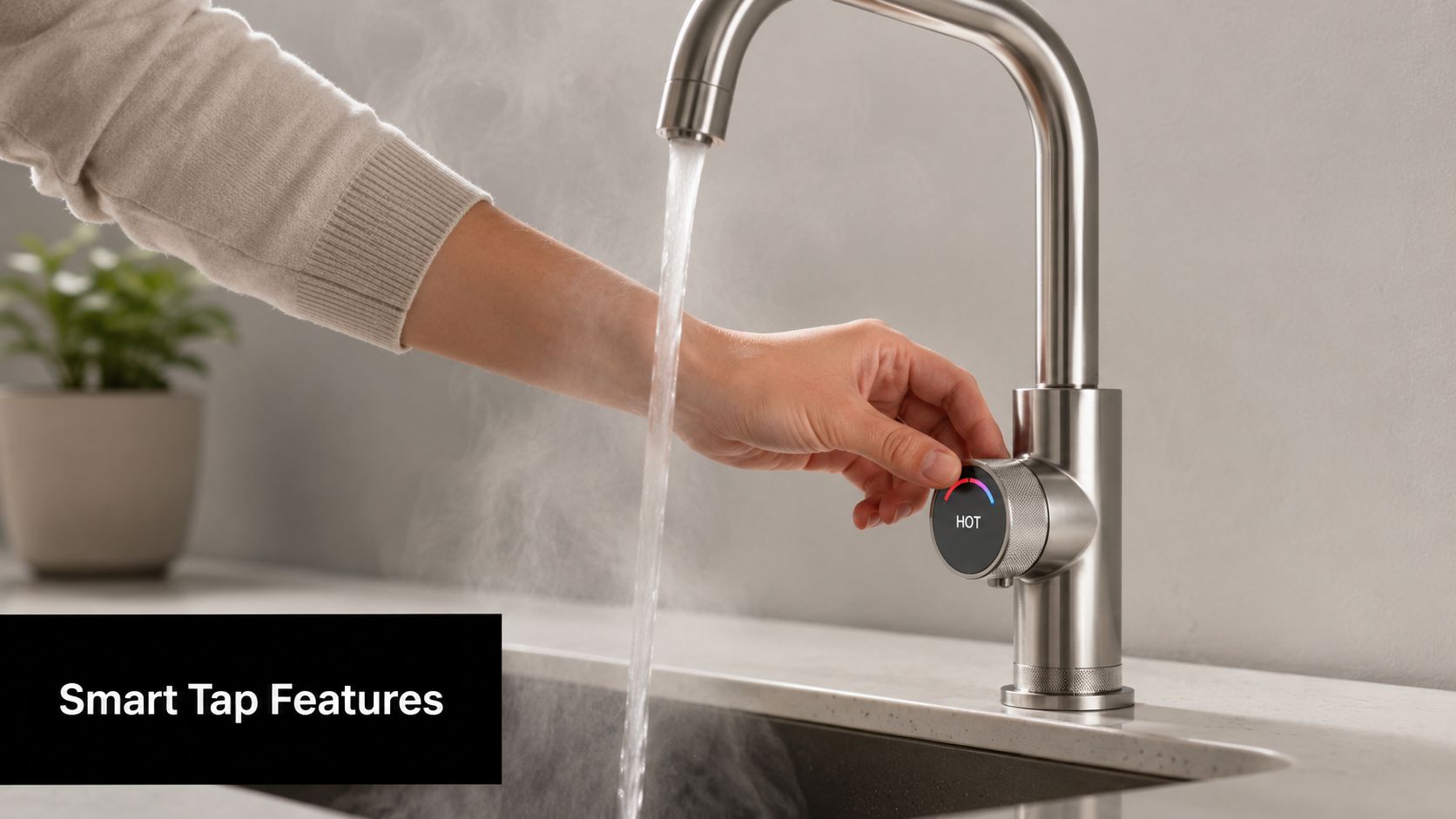
Start with safety. Any tap delivering near-boiling or boiling water should have a control system that reduces accidental activation. In family homes, that's not a nice extra. It's basic risk management.
Then check how the tap body handles heat. A well-designed outlet and insulated touch points make the unit safer and more comfortable to use. Premium products from brands such as Zip, Billi, and Stiebel Eltron usually make this easier to assess because the design intent is clearer.
Features that affect long-term efficiency
Some features don't look exciting in a showroom, but they matter more after the first year:
- Good under-sink insulation keeps standby losses under control.
- Adjustable temperature settings help align the unit with actual use instead of running hotter than needed.
- Accessible filters and service parts make maintenance more likely to happen on time.
- Durable internal components matter because worn valves, scale build-up, and struggling elements can degrade performance.
Choose the unit you'll maintain properly, not just the one with the flashiest tap head.
Features that may or may not be worth paying for
Integrated filtration can be excellent, especially if taste matters or your area has challenging water quality. But filters add recurring maintenance and replacement cost. Chilled and sparkling functions can also be fantastic if you'll use them. If not, they can turn a simple hot water decision into an expensive lifestyle appliance.
A sensible buyer usually separates features into three buckets:
- Non-negotiables such as safety controls, compliance, and service support.
- Performance items such as insulation and stable delivery temperature.
- Lifestyle extras such as chilled water, filtered water, and design finishes.
That framework stops you paying premium money for features that won't get used.
Installation and Maintenance for Long Term Efficiency
A well-chosen tap can still perform poorly if the installation is sloppy. Undersized electrical supply, awkward pipe runs, poor ventilation around the unit, or a rushed setup under a cramped sink can all hurt performance.
Professional installation matters because these systems combine water, heat, and in many cases significant electrical load. The tap itself is only part of the job. The under-sink layout, isolation valves, filtration setup, and service access all affect how the system behaves over time.
Keep efficiency from slipping
A simple maintenance routine goes a long way:
- Replace filters on schedule if your system uses them
- Descale when needed in hard water areas
- Check for slow flow or unusual cycling because that can point to blockage, scale, or a tired component
- Use genuine compatible parts when servicing valves, elements, or fittings
Neglected units often don't fail all at once. They usually become less convenient first, then less efficient, then unreliable.
If you want the benefits of an instant boiling or chilled water system without guesswork, Ring Hot Water can help with product advice, genuine parts, and professional installation support for Melbourne homes and workplaces.

