
Uncategorized
What Are the Benefits of a Boiling Water Tap for My Home
Jun
If you're reading this while the kettle is boiling for the second or third time today, you're not alone. In a lot of Melbourne homes, the kettle has become background noise. It fills, boils, gets half-used, sits there, then gets boiled again an hour later. Add in the cord on the bench, the limescale, the wait, and the shuffle around breakfast traffic, and it starts to feel less like a small appliance and more like a daily interruption.
That's where a boiling water tap changes the rhythm of the kitchen. Not because it's flashy, and not because every home needs one, but because it removes a repetitive task that has just been accepted. For households that make tea and coffee regularly, cook often, or want a cleaner, more functional kitchen, the benefits are real.
The better question isn't just “what are the benefits of a boiling water tap for my home”. It's whether those benefits match how your household uses the kitchen. In practice, the answer usually comes down to four things: convenience, running costs, bench space, and whether you also want proper filtration rather than just hot water on demand.
The End of the Kettle Waiting Game
It's easy not to think much about the kettle until you notice how often you're using it. Morning tea. Coffee after school drop-off. Hot water for noodles at lunch. Filling a saucepan at dinner. Then someone wants another cuppa and the whole cycle starts again.
In a busy home, the wait is what wears thin. You fill the kettle, stand there for a moment, walk away, come back, realise someone else used the water, and start over. The noise cuts through the kitchen, the outside stays on the bench full time, and the cord always seems to sit exactly where you want working space.
A boiling water tap changes that workflow immediately. Turn the handle or press the control, and the hot water is there. No separate appliance. No waiting for a boil cycle. No repeated refilling. If you're weighing up whether it makes sense to replace your kettle with a tap, the biggest shift isn't style. It's that the kitchen stops pausing for hot water.
Where it feels different day to day
The benefit shows up in the small moments:
- School mornings: one person makes tea while another gets breakfast moving.
- Cooking prep: a pot gets hot water straight away instead of waiting on a kettle first.
- Entertaining: guests aren't waiting while you boil batch after batch.
- Late-night use: no loud kettle roaring when the house is winding down.
A boiling water tap isn't magic. It just removes one of the most common little delays in a kitchen.
That's why people who install one often talk about it less as a luxury and more as a habit change. Once instant boiling water is built into the sink area, the old kettle routine starts to feel clunky very quickly.
Instant Convenience The Ultimate Kitchen Time Saver
The fastest benefit to notice is time. Not theoretical time. Actual kitchen minutes that stop disappearing into small waiting periods.
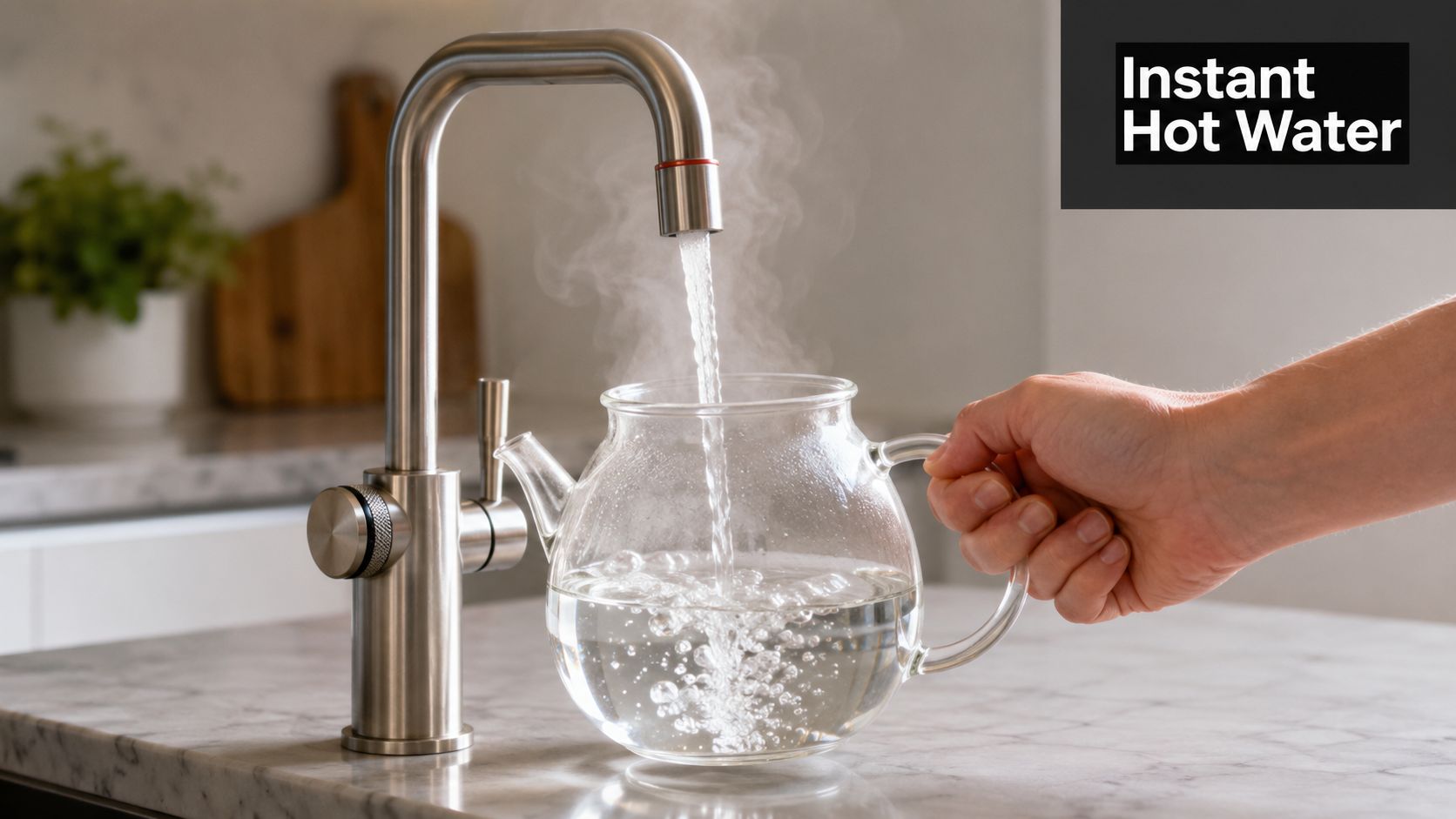
Independent consumer guidance says boiling-water taps remove the waiting associated with kettles and can save roughly 15 to 20 minutes per day in a standard household where hot water gets used several times daily, according to DD Wilson's guide to boiling-water taps. That sounds minor until you add up how often you reach for boiling water without thinking about it.
The daily jobs it speeds up
Tea and coffee are the obvious examples, but they're not the only ones. In many homes, the bigger value comes from all the other little jobs that need hot water quickly.
- Cooking: pasta water gets a head start, couscous and noodles are faster, and blanching vegetables is easier.
- Cleaning: grease loosens faster, sticky residue softens sooner, and you can rinse utensils or containers with near-boiling water straight away.
- Family use: baby bottle prep, warming tasks, and quick sterilising jobs become simpler.
- Shared kitchens: two people can move through the space without waiting on one appliance.
A kettle creates a bottleneck because it can only do one job at a time. A boiling water tap removes that bottleneck from the bench and places the function where you already work: at the sink.
Why the time saving feels bigger than the number
There's a practical difference between saving a block of time and removing friction from ten small tasks. In kitchens, the second one usually matters more. You're not scheduling around hot water. You're just getting on with what you were already doing.
That changes the feel of a kitchen, especially in Melbourne homes where the kitchen often doubles as the social centre of the house. You can make tea while talking. You can start dinner prep without waiting for one appliance to finish. You can clean up faster at the end.
For a quick visual, this video shows the kind of use pattern that makes these taps attractive in everyday kitchens.
Convenience works best when usage is frequent
This is also where I'd be practical about it. If your home barely uses a kettle, the convenience benefit won't land the same way. But if your household is constantly boiling water for drinks, cooking, or quick cleaning, the upgrade feels immediate.
Practical rule: The more often your household reaches for boiling water, the more a boiling tap earns its keep.
Real Energy Savings for Australian Homes
A lot of homeowners assume an always-ready boiling water tap must be expensive to run. That's the first concern I hear. It's a fair question, especially with Melbourne households watching power bills closely.
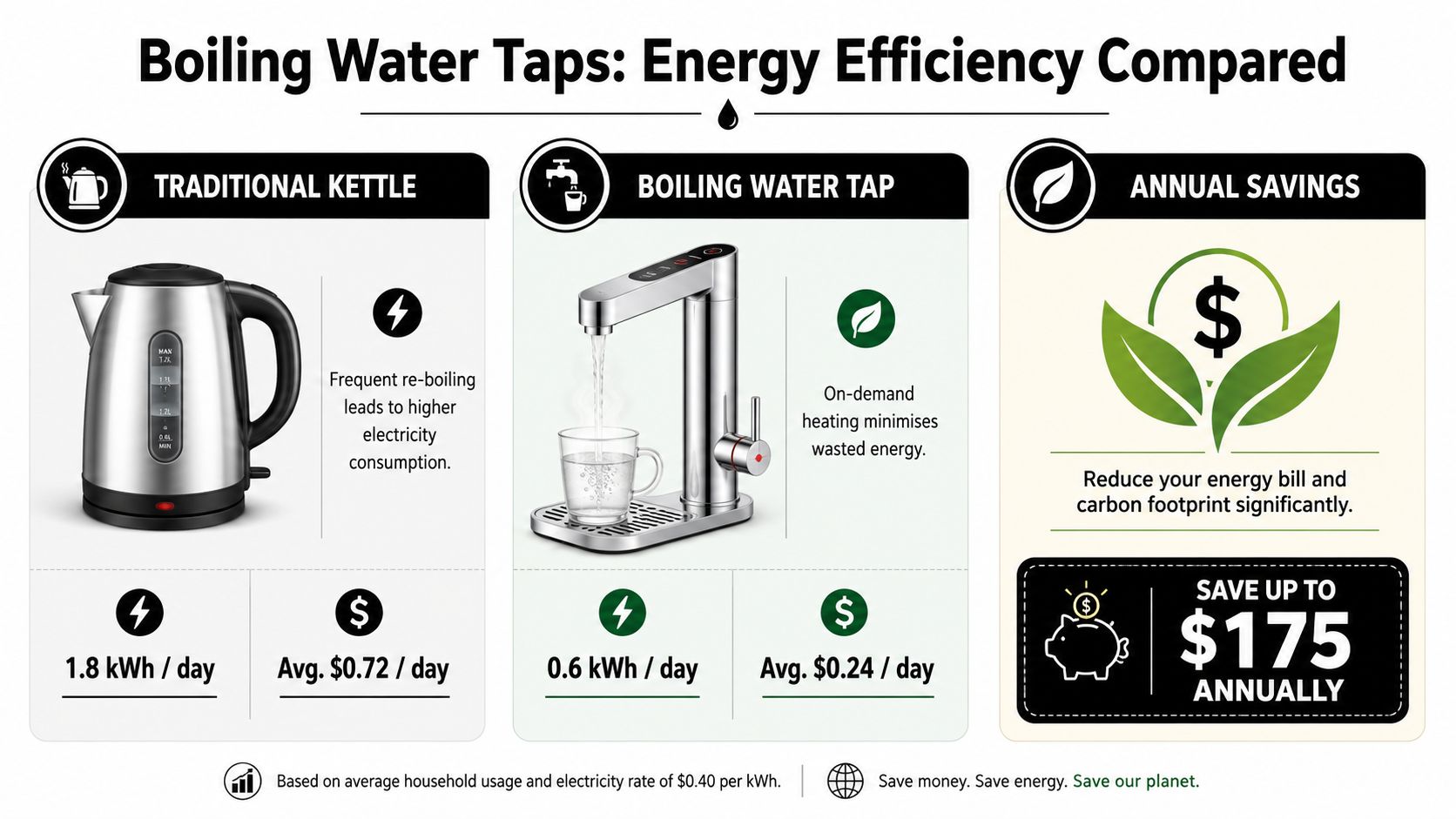
The answer is that the energy story depends less on the phrase “always on” and more on how the system uses power. A kettle pulls a heavy load every time it boils. Industry guidance commonly reports that boiling water taps can use up to 50% less energy than repeatedly boiling a kettle because they maintain a small insulated tank rather than reheating a full kettle each time, as outlined by Brita's comparison of boiling-water taps and kettles. The same guidance describes standby draw as about 10 watts, compared with a kettle that typically draws 2,000 to 3,000 watts during boiling.
Why kettles waste more than people think
In real homes, kettles are rarely used perfectly. People overfill them. They reboil water that has gone lukewarm. They boil a full kettle when they only need one mug. That's where a lot of waste creeps in.
Benchmarks in the verified data note that about 67% of people overfill their kettle daily, which leads to substantial wasted energy and emissions. That rings true in practice. Most households don't measure to the cup. They fill above what they need because it's quicker in the moment, then pay for heating excess water over and over.
What the running cost logic looks like
One source cited in the verified data describes running costs of around 3p per day for a boiling-water tap versus about 7p to boil a full kettle under UK pricing assumptions, and another source cites a delivered cost of about 1p per litre. Those exact figures aren't directly transferable to Australia because local tariffs differ, but the operating logic still applies: a boiling water tap tends to be more efficient when it dispenses only the water you use and avoids repeated full-boil cycles.
Here's the practical comparison homeowners usually care about:
| Household habit | What usually happens with a kettle | What usually happens with a boiling tap |
|---|---|---|
| One cup of tea | More water gets boiled than needed | Only the required amount is dispensed |
| Multiple uses across the day | The kettle reheats from scratch repeatedly | The unit maintains ready temperature efficiently |
| Shared household | Different people reboil separately | Hot water is available immediately |
| Cooking prep | Water often gets boiled twice, kettle then pot | Pot can be started with hot water straight away |
Where Australian households see the benefit
The strongest savings usually show up in homes that:
- Use hot water often: regular tea, coffee, cooking and cleaning create more opportunity to avoid waste.
- Overfill the kettle out of habit: this is common and it adds up.
- Have several people in the house: repeated boiling across the day is where kettles become inefficient.
- Want lower kitchen waste as well as lower energy waste: using only what you need helps both.
There is a trade-off. A boiling tap maintains temperature in the background, so if you almost never use it, the efficiency case is weaker. This isn't a miracle saver for every home. It makes the most sense when the tap gets used enough to justify its standby operation.
In Melbourne homes with steady daily use, the energy advantage usually comes from cutting waste, not from pretending the unit uses no power.
That distinction matters. The best outcomes come from households that value convenience and use boiling water regularly. When both are true, the running-cost case gets much stronger.
Superior Water Purity and Taste with Filtration
This is the point many homeowners get wrong. A boiling water tap and a filtered water system are related, but they're not the same thing.
Boiling water is useful for microbial safety. Filtration is what addresses taste, chlorine, sediment, and some chemical contaminants. If you want to make better decisions about your kitchen water, that distinction matters more than the marketing language on the box.
Boiling does one job. Filtration does another
General guidance on boiled versus filtered water makes it clear that boiling does not remove many chemical contaminants, and in some cases it can concentrate contaminants such as lead. That's why boiling is best understood as a microbial-kill method, not a complete treatment solution, as explained in Aquasana's boiled-water versus filtered-water guide.
Boiling is helpful when the concern is germs. It is not the answer for every water-quality question.
That's particularly relevant in Australian homes with older plumbing, tank water, or local taste and odour issues. People often ask whether an instant boiling tap makes water “healthier”. On its own, not necessarily. It makes hot water easier to access. The health and taste improvement comes from the filter stage.
What a filtered boiling tap can improve
Boiling water taps with activated carbon filters physically remove impurities such as lead, arsenic, and nitrates, which boiling alone cannot. Expert data in the verified information also confirms that filtration is significantly more effective at removing chemical contaminants critical to human health than boiling, which is only suitable for emergency microbial disinfection.
For homeowners, that usually translates into a few practical benefits:
- Better taste: reduced chlorine and off-notes in drinking water.
- Cleaner smell: especially noticeable in tea, coffee, and plain chilled water.
- Improved clarity: less visible sediment where source water or plumbing contributes particles.
- More confidence at the tap: especially in homes with ageing internal pipework.
If you're looking into a system that combines instant hot water with proper filtration, it helps to understand the role of an under-sink water filter in Melbourne homes. The filter does the purification work. The boiling feature does the convenience work.
Don't treat “boiling” and “filtered” as interchangeable terms. They solve different problems.
Where this matters most in everyday use
The difference becomes obvious in the cup. Tea tastes cleaner. Coffee is less affected by chlorine. Even cooking water can smell and taste better when the filtration is doing its job before the water reaches the glass, kettle zone, or cooking pot.
For households with young kids, pregnant women, or anyone who wants better-tasting everyday water, the value isn't just speed. It's having water that is both convenient to use and better treated for regular consumption.
Reclaim Your Bench Space with Sleek Design
A kettle doesn't just use electricity. It uses territory.
Most kitchens already have enough on the bench. Toaster. Coffee machine. Knife block. Maybe a dish rack, charger, fruit bowl, or a filter jug squeezed into the remaining space. Add a kettle and its cord, and the prep zone gets smaller again.
What changes visually
A boiling water tap shifts the bulky part of the system below the sink. What remains above the bench is a single fixture integrated into the sink area, which usually looks cleaner than a separate kettle and filter jug arrangement.
In systems that also dispense chilled and sparkling water, the space gain can be even more noticeable. The verified data notes that a single spout handling boiling, chilled, and often filtered sparkling water can reduce kitchen clutter and bench space usage by 30 to 40%.
Why this matters in Melbourne kitchens
Not every home has a huge island bench or oversized butler's pantry. In plenty of Melbourne homes, especially inner and middle-ring suburbs, the kitchen works hard within a modest footprint. Bench space has to serve prep, serving, appliances, and family traffic all at once.
That's why this benefit is more than aesthetics. It affects how the kitchen works.
- More prep room: there's more usable surface for chopping and plating.
- Cleaner sightlines: fewer standalone appliances make the room feel calmer.
- Less visual clutter: one integrated tap reads as part of the kitchen, not an add-on.
- Better appliance discipline: when a multi-function tap replaces several items, the bench stops becoming storage for small machines.
Style matters, but function matters more
There's no point pretending everyone installs a boiling tap only for efficiency. Design is part of the appeal. A well-chosen tap can make a kitchen feel more organised and more modern.
But the better argument is practical. When you remove a kettle and, in some homes, a water filter jug as well, the kitchen becomes easier to use and easier to keep tidy. That's especially valuable if the bench is already doing too much.
Installation and Maintenance for Melbourne Homes
The main hesitation after cost is usually practical: will it fit, and what does upkeep involve?
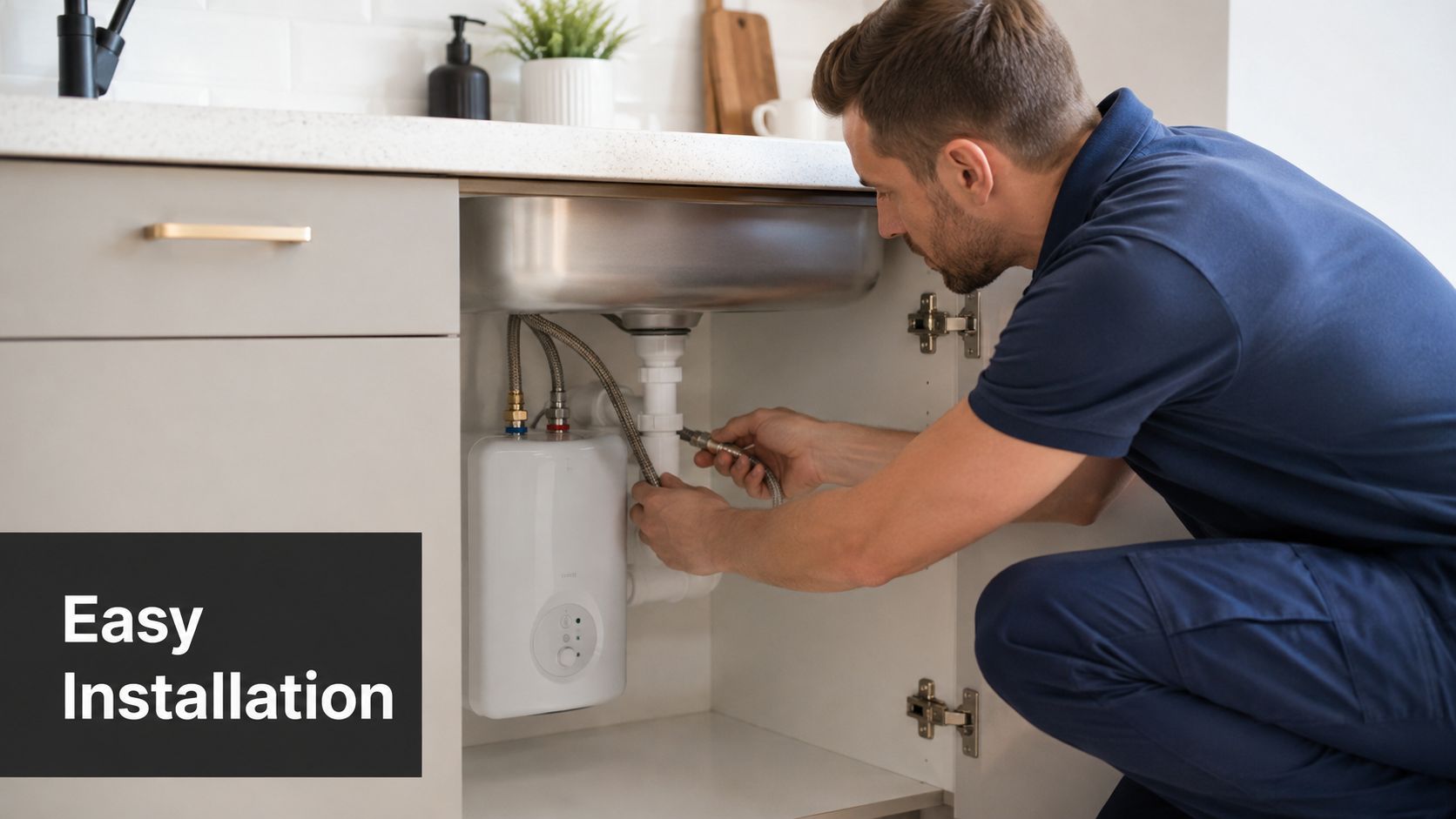
The short answer is that installation is straightforward in the right kitchen, but it should be assessed properly. A boiling water tap isn't difficult for a trained installer. It does, however, need the right conditions under the sink.
What the installer checks first
In most Melbourne homes, the key questions are simple:
- Cabinet space: is there enough room under the sink for the tank and any filter hardware?
- Power access: is there a suitable power point nearby?
- Water connections: can the unit be connected cleanly to the cold water supply?
- Tap position: is there enough room at the sink for the tap body and its operation?
Older homes can still be good candidates, but they sometimes need a bit more planning around cabinetry, power access, or existing plumbing layouts.
A modern instant hot water tap system is usually compact enough for a standard under-sink setup, but not every cabinet is equal. Cleaning chemicals, bins, pull-out systems, and pipework often compete for the same space, so a proper look matters.
What maintenance actually involves
This isn't a high-maintenance appliance, but it isn't a fit-and-forget item either.
For most homeowners, maintenance comes down to:
- Filter replacement: if the unit includes filtration, cartridges need replacing on schedule.
- General servicing: seals, connections, and performance should be checked periodically.
- Keeping the tap in good order: as with any kitchen fitting, regular cleaning helps preserve finish and operation.
If your home has harder water or a lot of mineral content, maintenance becomes more important. That doesn't make the system a poor choice. It just means servicing should be part of the ownership plan from the start.
A good installation isn't only about getting the tap working. It's about making sure the unit is accessible for future filter changes and service.
What doesn't work well
There are a few situations where I'd tell a homeowner to pause and assess before charging ahead.
| Situation | Why it needs attention |
|---|---|
| Very tight under-sink cabinet | The unit may fit poorly or become awkward to service |
| No nearby power point | Electrical work may be needed |
| You rarely use boiling water | Convenience and running-cost value may be limited |
| You want “purified” water without a filter | The expectation doesn't match what boiling alone does |
That last point matters. If your goal is better water quality, choose a system with suitable filtration. If your goal is speed and kitchen efficiency, the boiling function may be enough on its own. Plenty of homeowners want both, and that's often the smartest setup.
Your Boiling Water Tap Questions Answered
Homeowners usually ask the same handful of questions once they get past the idea stage. Here are the direct answers.
Are boiling water taps safe?
Yes, modern units are built with safety in mind, but they still need sensible use. Many models include child-safety controls and dispensing mechanisms designed to reduce accidental activation. As with any source of near-boiling water, proper installation and correct everyday use matter.
Is a boiling water tap worth it if I'm focused on cost?
It can be, but only if your household will use it often enough. If you make hot drinks throughout the day, cook regularly, and want to reduce kettle waste, the value is easier to justify. If you only boil water occasionally, the convenience benefit may be real but the financial case will be weaker.
Does it replace filtration?
Not automatically. A boiling tap provides instant hot water. Filtration is a separate function, even when both features are built into the same system. If taste, chlorine, sediment, or certain contaminants are concerns, choose a model with proper filtration.
Can one tap really replace several appliances?
In many kitchens, yes. The verified data notes that a single spout providing boiling, chilled, and often filtered sparkling water can reduce clutter and bench-space usage by 30 to 40%. That can remove the need for a kettle, a filter jug, and sometimes other drink-prep gear.
What about installation pricing?
Pricing varies by product, filtration setup, cabinetry, and whether electrical or plumbing adjustments are needed. If you're trying to understand how tap replacement pricing is typically broken down, even outside Australia, this guide to kitchen tap replacement cost UK is useful because it explains the cost drivers in plain language. The same logic applies here: fixture choice, access, labour, and what needs adapting on site.
A boiling water tap is at its best when it solves a real daily frustration. If your kitchen runs on tea, coffee, quick meals, family traffic, and limited bench space, it's one of the upgrades you'll notice every single day.
If you want practical advice on the right boiling, chilled, or filtered tap setup for your kitchen, Ring Hot Water can help. They supply, install, service, and maintain instant hot water systems across Melbourne, with genuine parts and straightforward guidance for homeowners who want a system that fits the way they live.

