
Uncategorized
Insinkerator Hot Water Tap: The Ultimate Melbourne Guide

Jun
The kettle is still one of the most common bottlenecks in a Melbourne kitchen. It clutters the bench, it makes noise, and it slows down small jobs that should take seconds. You want one mug of tea, a quick French press, or hot water to loosen something on a plate, and you're still waiting around for a full boil cycle.
That's usually the point where people start looking at an InSinkErator hot water tap. Not as a flashy add-on, but as a practical upgrade that changes how the sink area works day to day. In a busy home, that matters in the morning rush. In an office kitchen, it matters every hour.
The End of the Kettle An Introduction
A common driver for enquiring about an InSinkErator hot water tap is a weariness with the same routine. The kettle lives permanently on the bench. Someone fills it with more water than they need. It boils slowly when everyone wants it at once. Then it goes quiet until the next small interruption.
A dedicated hot water tap fixes that friction at the point of use. You turn the handle, fill the cup or jug, and move on. The bench looks cleaner because the appliance is under the sink, not parked next to the toaster. That sounds minor until you live with it for a few weeks.
The change is even more obvious in homes where people prepare hot drinks differently. One person wants tea, another wants long black, someone else needs hot water for oats or instant noodles. If you still use a kettle for pour-over coffee, a practical companion read is Cartograph Coffee's electric kettle guide, which helps clarify when a kettle still makes sense and when a fixed tap setup is the better fit.
Where the upgrade pays off
A hot water tap earns its place when the sink is already a working zone, not just a washing-up spot.
- Morning drink prep: Tea, coffee, porridge, and kids' lunches all pull from the same source.
- Food prep: Blanching, soaking, loosening lids, and speeding up boiling on the cooktop become easier.
- Office use: Staff stop queueing around one shared kettle.
- Bench space: The appliance moves below the sink, where it belongs.
Practical rule: If you're boiling water several times a day and the kettle never leaves the bench, you're already the right kind of user for this system.
What catches buyers out isn't usually the idea. It's the practical side. Will it fit under the sink? Can it go into stone? Who services it locally? Can you still get proper parts later? Those are the questions that matter once the brochure language wears off.
How an Insinkerator Hot Water Tap Works
An InSinkErator hot water tap is best understood as a mini hot water service for one sink. What you see above the benchtop is only the outlet. The main work happens underneath, where the system stores, heats, and delivers water on demand.
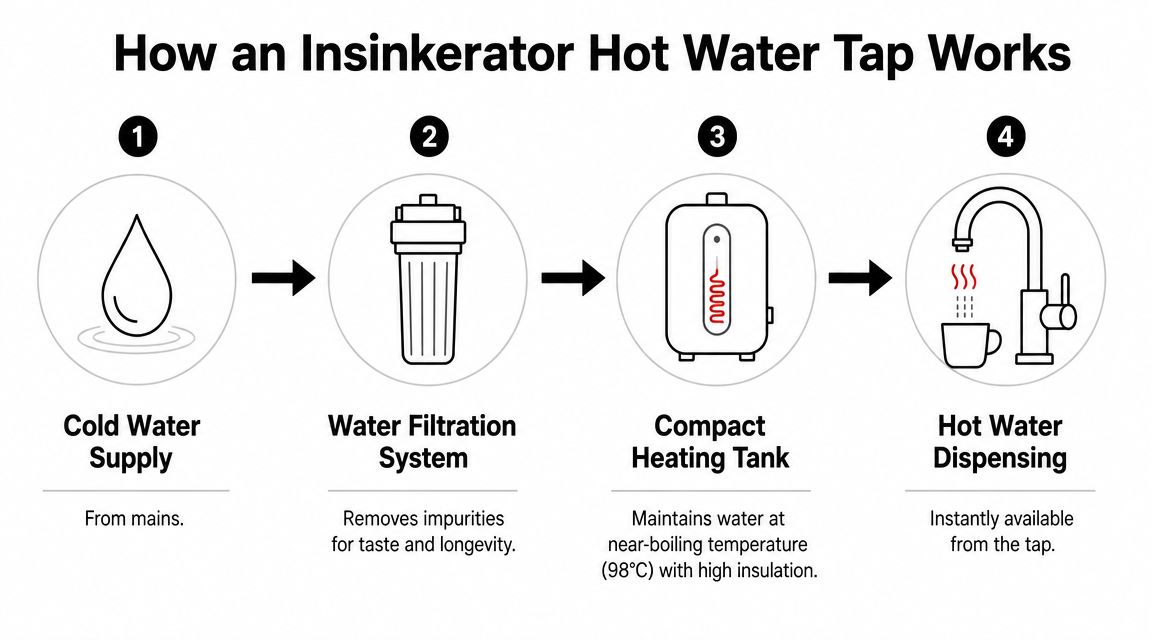
The main parts under and above the bench
The visible part is the dedicated dispenser faucet. One Australian-market example, the HOT150, is sold with standard filtration and a 1-handle, 6.25-inch chrome faucet on its Home Depot product listing.
Under the sink, you've got a compact tank. InSinkErator's long-standing design is a tank-and-faucet under-sink system. The installation guide also makes two practical points that matter in real kitchens: the unit needs an electrical outlet under the sink, and the maximum distance between the tank and faucet should not exceed 16 inches for reliable operation, as noted in the InSinkErator installation guide.
A filter is often part of the system as well. That helps with taste and can reduce the amount of debris reaching the working parts.
What happens when you turn it on
The flow is simple.
- Cold mains water enters the system.
- The water passes through filtration if the model includes it.
- The under-sink tank heats and stores the water at a set temperature.
- The faucet dispenses near-boiling water immediately when you operate it.
That stored-heat design is why these units feel instant in normal use. They aren't creating a full kettle boil from cold every single time you open the tap. They maintain a ready volume of hot water inside an insulated tank.
Why output depends on demand pattern
Marketing descriptions and practical operation often diverge. Hot water taps perform best with short, repeated draws, not long uninterrupted filling sessions. The system relies on tank capacity, thermostat setting, and recovery time.
InSinkErator hot-water systems are described in examples with small under-sink tanks in the range of 1/3 to 2/3 gallon, adjustable thermostat bands around 160 to 210°F, and some models rated at roughly 40 to 60 cups per hour, according to InSinkErator product Q&A information on Home Depot.
For Australian buyers, one concrete benchmark is the HOT150, which is rated to deliver up to 60 cups of near-boiling water per hour on the HOT150 product page.
In practice, that means an InSinkErator hot water tap handles homes, staff rooms, and light hospitality-style drink service well, but you still need to size expectations around recovery if multiple people draw heavily back to back.
Choosing the Right Insinkerator Model for You
The right model depends less on brand loyalty and more on how your sink is used. Some buyers want one dedicated outlet for near-boiling water. Others want a combined fixture that changes the whole sink layout and replaces more than one tap function.
Start with the job you want the tap to do
If the goal is simple drink and prep convenience, a dedicated hot water dispenser is usually the cleaner choice. It keeps the system focused and avoids making the main mixer more complicated than it needs to be.
If you're redesigning the whole sink zone, an integrated multi-function tap can make sense. Those models suit renovations where visual simplicity matters and you want fewer fixtures through the bench.
Here's the practical divide:
- Dedicated hot water tap: Better if you already like your existing mixer or want a straightforward retrofit.
- Integrated hot and standard water tap: Better if you're replacing the sink mixer anyway and want one coordinated fixture.
- Filtered configuration: Better if taste matters and you want one system handling both convenience and water quality at the point of use.
Think about finish after function
Finish matters, but it shouldn't be the first decision. Chrome is usually the easiest option to match, keep clean, and service later. Dark finishes can look excellent in modern kitchens, but they're less forgiving if the rest of the tapware doesn't align.
For offices and utility kitchens, appearance usually matters less than serviceability. In those spaces, simple and common finishes are easier to live with.
Compare by use case, not brochure language
| Insinkerator Model Comparison | Functions | Best For | Available Finishes |
|---|---|---|---|
| HOT150 | Near-boiling water with filtration | Homes, offices, staff kitchens needing frequent hot water draws | Chrome |
| H3300 | Boiling and filtered water configuration | Buyers wanting a more premium sink setup with filtration focus | Varies by product offering |
| 3N1-style integrated models | Combined tap functions in one fixture | Renovations aiming to reduce separate sink fittings | Varies by product offering |
The H3300 type of setup is worth a look if you want a higher-spec filtered boiling water tap rather than an entry-level dispenser. A current local product example is the InSinkErator H3300 boiling water tap.
What usually works best in Melbourne homes
In established Melbourne homes, retrofits often favour dedicated units because they create fewer surprises. You're working around existing plumbing, waste lines, cleaning products under the sink, and sometimes awkward cabinetry. A separate faucet can be easier to place than a full integrated replacement.
For newer renovations, integrated designs can look cleaner, but they demand better planning. The tap hole position, sink layout, and under-bench access all need to line up.
Buyer's shortcut: Choose the model based on sink layout first, usage second, and finish third. People often reverse that order and end up forcing a nice-looking tap into a bad installation.
A final point. Don't buy purely on the promise of “instant boiling water”. Most systems in this category deliver near-boiling water in practical use, which is exactly what most kitchens need. The better question is whether the unit fits your cabinet, suits your benchtop, and matches the way your household or office uses hot water.
Planning Your Insinkerator Tap Installation
Installation is where most expensive mistakes happen. Not because the product is flawed, but because kitchens vary wildly. A clean install depends on space, power, plumbing access, and benchtop material all working together.
Start with the physical reality under the sink, not the picture on the box.
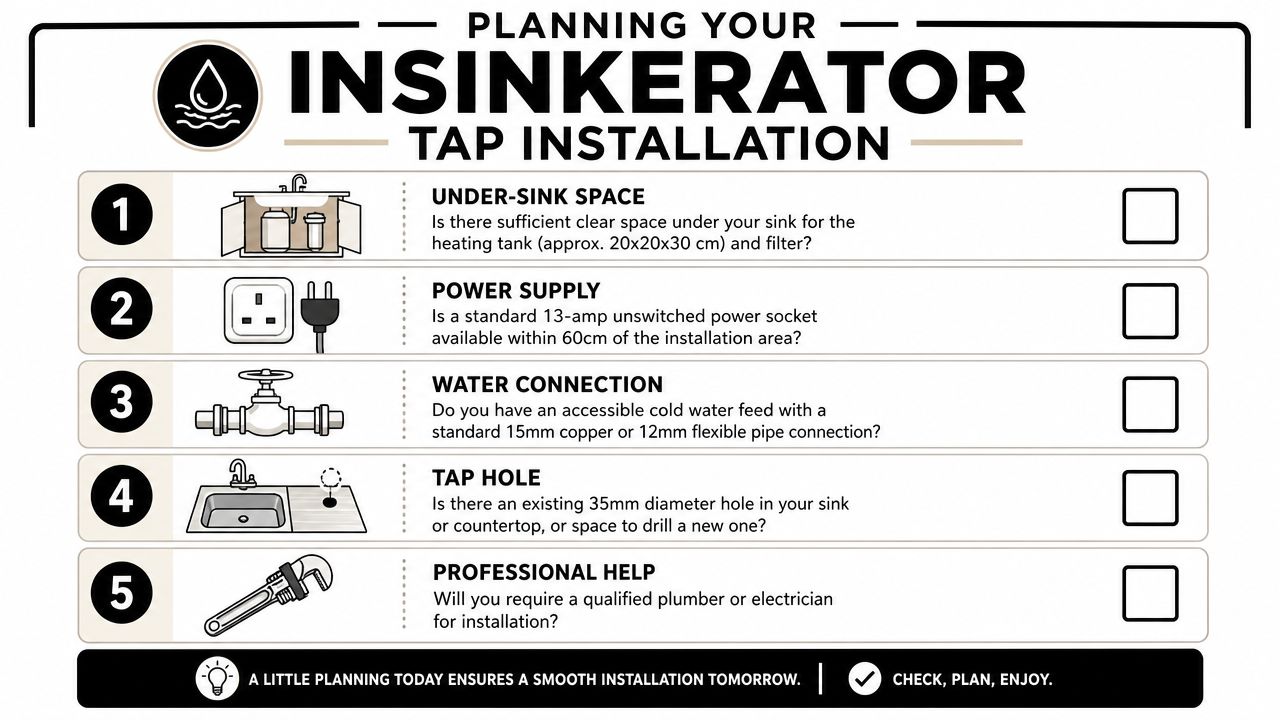
The checks that matter before you order
Open the cabinet and look properly. Not a quick glance. You need to know whether there's a sensible mounting position for the tank and filter that doesn't interfere with the waste, pull-out bins, stored chemicals, or cleaning gear.
A useful pre-purchase reference on system layout and installation considerations is this guide to under-sink hot water systems.
Work through these points before anyone drills a hole:
- Cabinet space: Confirm there's clear room for the tank and associated fittings without crushing hoses.
- Power access: InSinkErator's guidance requires a grounded outlet under the sink.
- Cold water connection: The installer needs a clean, accessible feed point.
- Tap location: The faucet must sit where it can be used comfortably and where the under-bench mounting path makes sense.
- Service access: Filters and fittings must remain reachable after installation.
Stone and engineered stone need extra care
This is the part many generic product pages skip. Benchtop compatibility often decides whether the job is straightforward or awkward.
InSinkErator's own guidance specifies that the counter must be 3 inches thick or less, and independent installers note that stone-edge distance and drill technique are critical if you want to avoid cracking or misalignment, as discussed in this independent installation video.
Don't treat a stone benchtop like a laminate top with a harder surface. Hole position and drilling method have to respect the material, the edge distance, and what's happening underneath.
A lot of Melbourne renovations use stone or engineered stone. That makes pre-install planning more important than the tap choice itself. If the hole lands too close to an edge, too close to another fitting, or above cluttered plumbing, you've created a problem before the tank is even mounted.
This walkthrough gives a visual sense of how installers approach these systems in practice.
When professional installation is worth it
A handy homeowner can understand the system. That doesn't mean every kitchen is a good DIY candidate. Stone drilling, tight cabinetry, poor existing plumbing, and awkward powerpoint placement all push the job into trade territory quickly.
Professional installation is especially sensible when:
- You have stone or engineered stone
- The sink cabinet is crowded
- The existing plumbing is old or messy
- You want the finish to look factory-neat
- You need confidence that future servicing will be straightforward
The best installs aren't just functional. They leave enough order under the sink that the next filter change or service call isn't a wrestling match.
Maintenance Troubleshooting and Genuine Parts
An InSinkErator hot water tap is easy to enjoy and easy to neglect. The people who get the best life from these systems are usually the ones who treat them like a small appliance with plumbing attached, not like a passive tap that never needs attention.
What maintenance actually matters
The two recurring issues are water quality and flow restriction. If local water leaves mineral deposits, those deposits don't politely stop at the faucet. They can build up in the nozzle area and affect the way the system performs over time.
Independent guidance on instant hot-water dispensers notes that low flow is often fixed by flushing the tank and cleaning mineral deposits from the nozzle screen, and that draining and refilling may be part of routine service. That's outlined in this practical maintenance write-up on flushing an instant hot water heater with low flow.
For owners who care about drink quality as much as hardware protection, it also helps to understand what better filtration changes in the cup. This overview of PureHQ filters for better brewing is useful background if tea and coffee quality are part of the reason you're installing the tap in the first place.
Common symptoms and the likely cause
Not every problem means the tank is failing. Most service calls begin with a few predictable complaints.
| Common issue | What often causes it | What to check first |
|---|---|---|
| Reduced flow | Mineral build-up, blocked screen, overdue service | Nozzle screen, filter condition, flush history |
| Water not feeling hot enough | Thermostat setting, recovery lag after heavy use | Usage pattern, temperature setting |
| Dripping or inconsistent delivery | Installation layout or vent-path issue | Faucet-to-tank setup, service inspection |
| Poor taste | Old filter, stagnant maintenance routine | Filter replacement and flushing |
What you can do yourself
Some checks are reasonable for an owner. Others are better left to a technician.
Start with the simple items:
- Check the filter condition: A tired filter affects taste and can contribute to poor performance.
- Inspect the outlet area: Debris and scale around the nozzle can restrict flow.
- Think about usage pattern: If several people have drawn hot water back to back, recovery time may be the issue rather than a fault.
- Keep the cupboard clear: Crushed hoses and blocked access make minor issues harder to spot.
When to call for service
Call a technician if the unit keeps dripping, the temperature is unstable, or flow stays poor after basic cleaning and flushing. It's also smart to call when the under-sink space is so crowded that you can't inspect the unit properly without disconnecting items.
Service rule: If the symptom involves heat, electricity, or an internal leak path, stop troubleshooting at the surface level and book a proper inspection.
Why genuine parts matter
This isn't the place to save money with mystery parts. Taps, tanks, filters, thermostats, hoses, and fittings all rely on compatibility. A part that “almost fits” can create leaks, poor performance, or a system that's difficult to service later.
Use genuine replacement parts where possible, especially for components tied to temperature control, water delivery, and sealing. It keeps the unit predictable, and predictability is what you want under a sink cabinet.
Where to Buy and Service Your Tap in Melbourne
Buying the tap is the easy part. Buying it from the right place, with the right installation support and service pathway, is what protects the investment.
A big retailer can be fine if you already know the exact model, your bench is straightforward, and your plumber is comfortable with the product. The downside is that you often end up managing the whole chain yourself. Product selection, hole drilling, fit questions, spare parts, and future servicing can all land back on you.
Retailer versus specialist support
A specialist supplier usually adds value in three areas that matter after the sale:
- Model selection: You're less likely to choose a unit that doesn't suit your cabinet or sink layout.
- Installation quality: Stone, retrofits, and tight under-sink spaces need experience, not guesswork.
- Ongoing service: When something needs attention later, you know who supports the product.
That matters more in Melbourne than many buyers expect. Plenty of kitchens look standard from the front and become awkward the moment the cupboard doors open.
What to ask before you purchase
Before committing, ask the supplier or installer practical questions, not vague ones.
- Will this model suit my existing sink layout?
- Who drills the benchtop if a new hole is needed?
- Can you supply genuine replacement parts later?
- Who handles servicing if flow drops or the unit starts dripping?
- Do you support this brand locally, or just sell the box?
Those questions quickly separate a simple reseller from a business that deals with these systems in the field.
A local service path matters
For Melbourne buyers who want an ongoing support option rather than a one-off sale, local service availability is a key differentiator. If you need future maintenance or repair help, it's useful to have a dedicated service contact such as InSinkErator tap servicing in Melbourne.
The tap itself is only half the purchase. The other half is knowing who can still get parts and fix it cleanly when the novelty is long gone.
That's especially relevant for offices, staff kitchens, and higher-use homes. The more often the tap gets used, the less attractive it is to rely on generic support or chase parts from different sellers later.
Frequently Asked Questions
A few questions always come up just before purchase. Most are sensible. They're about fit, safety, running expectations, and whether the system will still be convenient once everyday ownership starts.
Straight answers before you buy
| Insinkerator FAQs | Answer |
|---|---|
| Question | Answer |
| Is the water actually boiling? | In normal use, these systems are generally described as delivering near-boiling water. For kitchen tasks and hot drinks, that's what most buyers want. |
| Can an InSinkErator hot water tap replace my kettle completely? | For many homes and offices, yes. If you regularly use a specialist pour-over kettle or need a particular pouring style for coffee, you may still keep one. |
| Is it safe for family homes? | Yes, when it's correctly installed and used as intended. Like any hot water fixture, it needs sensible handling and proper setup. |
| Will it fit in an older Melbourne kitchen? | Often yes, but older kitchens are where planning matters most. Under-sink space, powerpoint access, and benchtop material decide that. |
| Can it go into stone benchtops? | Usually yes, provided the benchtop and hole position are suitable and the drilling is done correctly. Stone work is one of the strongest reasons to use an experienced installer. |
| What causes slow flow later on? | Mineral deposits and maintenance neglect are common causes. Cleaning, flushing, and filter attention usually come before bigger repair work. |
| Do offices benefit as much as homes? | Often more. Staff kitchens with repeated small hot water draws are exactly where these systems feel most useful. |
| Should I buy parts from any plumbing supplier? | It's safer to match the system with proper compatible parts. That reduces the risk of leaks, poor fit, and future service complications. |
The main thing most buyers get wrong
People tend to over-focus on the visible tap and under-focus on the space below it. That's backwards. If the cabinet is cramped, the power access is poor, or the benchtop is risky to drill, you need to solve those issues first.
Once the installation is right, ownership is simple. Use it properly, keep up with filter and cleaning needs, and don't ignore early warning signs like reduced flow or odd dripping behaviour.
If you're choosing between “nice to have” and “worth it”, the answer usually comes down to daily use. In a kitchen that needs hot water repeatedly, an InSinkErator hot water tap stops being a luxury very quickly.
If you want help choosing, installing, or servicing an InSinkErator hot water tap in Melbourne, Ring Hot Water offers local support for under-sink boiling water systems, genuine parts, and ongoing maintenance.

