
Uncategorized
Hot Water Solar Controller: An Expert Guide

May
If you're looking at another power bill and wondering why your hot water still costs so much, you're not alone. In Melbourne homes, hot water is often one of the bigger energy users, and solar hot water only works properly when the system knows when to harvest heat and when to leave well enough alone.
That's where a hot water solar controller earns its keep. It's the part often overlooked until the pump runs at the wrong time, the booster cuts in too often, or the tank doesn't seem to stay hot. A good controller won't fix a badly sited collector or poor plumbing, but it will make a properly designed system behave the way it should.
What Is a Hot Water Solar Controller?
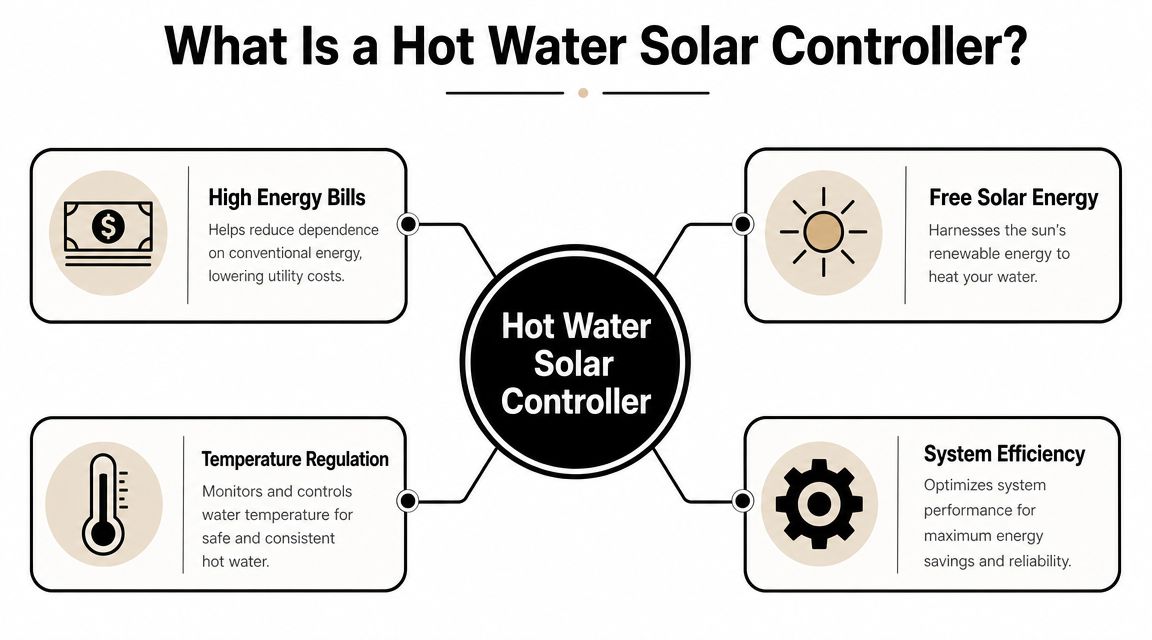
A hot water solar controller is the control brain of an active solar hot water system. It watches temperature at the collector and in the storage tank, then decides whether the pump should run. The aim is simple. Move useful solar heat into the tank when the roof is hotter, and stop the system when pumping would waste energy.
In Australian homes, that matters because water heating is a major household energy load, and solar hot water systems can meet roughly 40% to 70% of a home's hot-water needs when they're managed properly to capture sunlight and minimise backup heating, according to the solar water heating guidance referenced by WBDG.
What the controller actually does
It functions as a smart thermostat for the roof and the tank. It isn't there to “make heat”. The sun does that. The controller's job is to decide whether the heat available on the roof is worth collecting.
A decent controller usually handles a few practical tasks:
- Temperature comparison so the system only circulates when useful heat is available
- Pump switching so the circulation pump doesn't run unnecessarily
- Backup coordination in systems that also use gas or electric boosting
- Basic fault display so a technician can see if a sensor or control issue is developing
If you're trying to understand the heat transfer side of the system itself, Harrlie Plumbing's heat exchanger guide is a useful plain-English read because it explains how heat moves from one part of a water heating setup to another without getting too academic.
Why controllers matter in Melbourne
Melbourne isn't kind to sloppy solar control. You can get bright winter sun, passing cloud, cool evenings, and sharp overnight drops. Without proper control logic, a system can easily pump at the wrong time and dump stored heat back through the collector loop.
Practical rule: A solar system doesn't save money just because it has collectors on the roof. It saves money when the controller moves heat at the right time and stops moving it at the wrong time.
That's why active systems live or die on controller quality, sensor accuracy, and setup. If you want a visual overview of how these systems are arranged in practice, Ring Hot Water's page on solar hot water systems is a handy starting point.
How Solar Controllers Maximise Free Energy
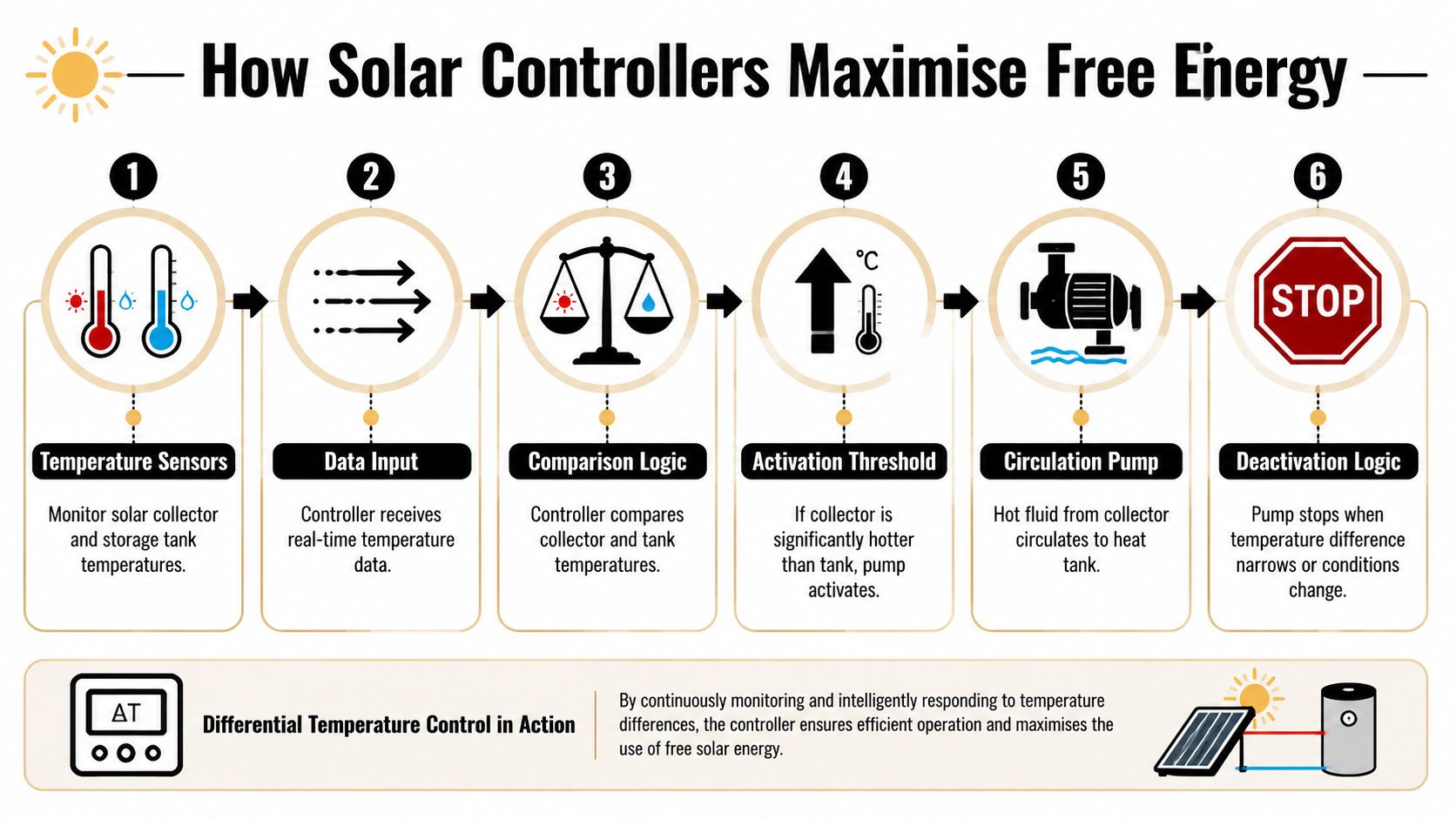
The controller's main trick is differential temperature control. That sounds technical, but the logic is straightforward. It compares the roof collector temperature with the tank temperature and only runs the pump when the collector is hotter by a preset amount.
The basic sequence
A standard forced-circulation system usually works like this:
- A sensor reads the collector temperature on the roof.
- Another sensor reads the tank temperature lower down where incoming solar heat can lift stored water temperature.
- The controller compares both readings.
- If the collector is hotter than the tank by the set differential, the pump starts.
- Solar-heated fluid transfers heat into the tank.
- When the temperature gap drops away, the pump stops.
That stop function is just as important as the start function. The core control logic in solar hot water controllers is based on a set delta-T, and it runs the pump only when the collector is hotter than the tank by a preset amount, which prevents nocturnal heat loss and pump short-cycling, as described in this solar controller operation reference video.
Why the stop point matters
A lot of poor-performing systems don't fail because the collector is bad. They fail because the control settings are wrong, the sensors are misplaced, or the controller keeps reacting too quickly to changing conditions.
In Melbourne, cloud edges and quick irradiance swings can make a collector temperature jump and fall fast. If the controller hysteresis is badly set, the pump starts, stops, starts again, and wears itself out while collecting very little useful heat.
A short visual can help if you want to see the general operating principle in action:
The house still matters
Even a well-set controller is only one part of the result. Collector orientation, shading, roof layout, and the building's broader thermal design all affect how much useful hot water you end up with.
That's why I tell people to think beyond the cylinder and the roof frame. If you're planning bigger energy upgrades, this piece on energy-efficient home architecture is worth reading because envelope design and passive solar thinking often influence how well any water heating strategy performs in day-to-day use.
If the collector sees poor sun, the controller can only manage the problem. It can't cure it.
Comparing Solar Controller Types and Features
The controller market makes more sense once you split it by job. One group runs a pumped solar thermal system. The other diverts surplus solar PV into a hot water element. Both are sold as hot water solar controllers, but they solve different problems and suit different Melbourne homes.
Differential controllers for solar thermal systems
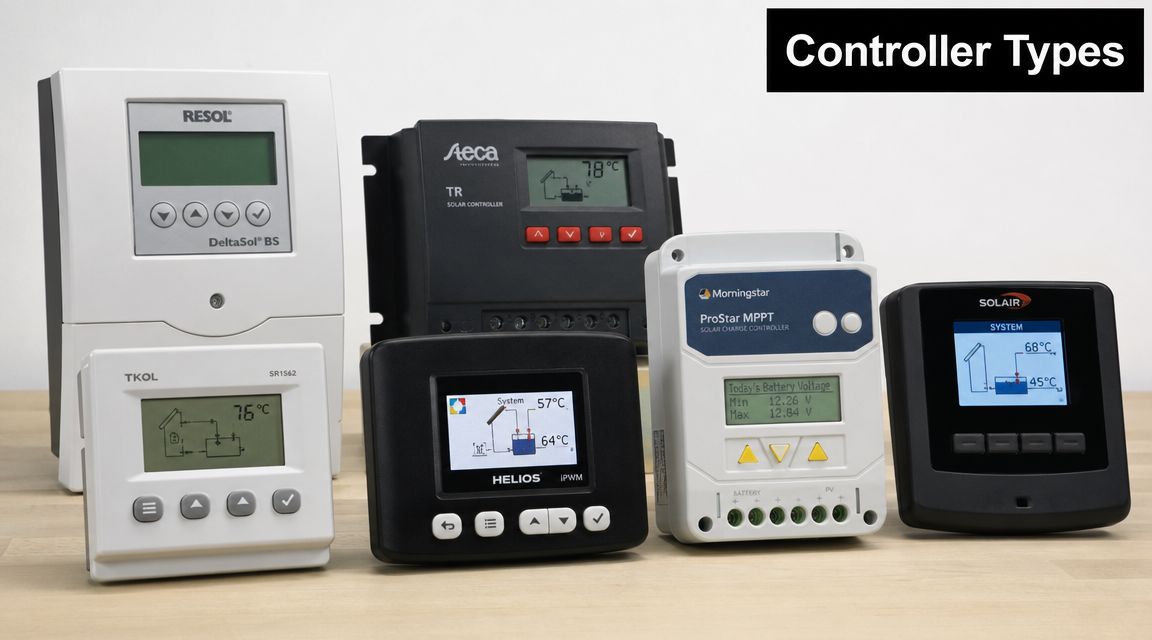
A standard solar thermal controller compares collector temperature with tank temperature and switches the circulation pump when there is useful heat to harvest. For a straightforward split-system setup, that is still the right tool. It is proven, serviceable, and easy to fault-find if the sensors and wiring are done properly.
On a simple domestic job, the features that matter are practical rather than flashy:
- Collector and tank sensors that match the controller
- Adjustable cut-in and cut-out differentials so the pump does not hunt on broken cloud days
- A relay rated for the actual pump load
- Clear fault codes or indicator lights for sensor and over-temperature faults
I usually favour a simpler controller on a standard Melbourne install with one collector bank and one tank. Fewer layers of logic means fewer nuisance faults and less time spent decoding menus during a service call.
Multi-function solar thermal controllers
The next tier adds more control over the whole hot water system, not just the collector loop. These units are useful where the layout is awkward, the tank has multiple temperature zones, or the backup heater needs tighter control so it does not wipe out your solar gain overnight.
Useful extra functions include:
- Booster control for electric or gas backup
- Tank top and bottom sensing to track stratification
- Overheat and holiday modes for periods of low hot water use in summer
- Multiple relay outputs for a pump, valve, recirculation function, or auxiliary load
- Better diagnostics for sensor faults, pump output faults, and high-temperature events
That extra control is not automatically better. It pays off on larger homes, evacuated tube systems, or sites with long pipe runs and more than one heat source. On a plain suburban install, it can add cost without adding much usable performance.
PV-direct hot water controllers
This is the newer comparison many homeowners need. A PV-direct controller does not run a solar thermal collector loop at all. It monitors excess electricity from rooftop PV and feeds that surplus into an electric hot water element.
For plenty of Melbourne homes, that changes the conversation. If the house already has a decent PV array, roof space is limited, and the existing cylinder can be adapted or replaced with a suitable storage unit, PV diversion can be simpler than installing a full solar thermal system with collectors, pump station, sensors, and glycol loop components.
The trade-off is straightforward. Solar thermal usually captures heat more efficiently from the roof area available. PV-direct is often easier to install, easier to service, and easier to understand. It also avoids some of the common thermal-system issues, such as pump failure, sensor faults, stagnation, and roof plumbing leaks.
Which features are worth paying for
Feature lists can get out of hand quickly, so I look at them in terms of site conditions and serviceability.
| Feature | Worth having | Why it matters |
|---|---|---|
| Adjustable differential settings | Yes | Lets the controller cope with Melbourne's fast weather changes and reduces pump short-cycling |
| Booster control | Usually | Stops backup heating from doing work the sun could have done later in the day |
| Multiple sensor inputs | Depends | Useful on stratified tanks, larger systems, and fault-finding |
| Multiple relays | Depends | Needed for more complex layouts, unnecessary on many standard homes |
| Detailed display or app monitoring | Nice to have | Helpful for diagnosis, but it does not fix poor design or bad sensor placement |
| PV export sensing | Yes, for PV-direct setups | Required if the goal is to use excess solar generation for water heating |
The main mistake is buying on feature count instead of matching the controller to the system. A basic differential unit that suits the pump, sensors, and tank will usually outperform a more complicated controller that has been poorly specified.
For Melbourne homes, the comparison is often broader than controller features alone. If the house needs an active pumped solar thermal system because the tank and collector cannot work as a passive setup, then a good differential or multi-function thermal controller is part of the answer. If the home already has strong daytime PV output and the owner wants lower install complexity, a PV-direct controller may be the cleaner option.
How to Choose the Right Solar Controller
The right controller starts with the system type, not the catalogue. Plenty of Melbourne homeowners ask for “the best controller” when the core question is whether they should be running an active pumped system at all, or whether they'd be better off with a simpler arrangement.
When an active system is necessary
A passive thermosiphon setup is attractive because it's simple. Fewer moving parts, less control hardware, less to go wrong. But passive systems don't suit every roof or every house.
A controller-driven active system becomes the smarter choice when:
The tank can't sit where thermosiphon needs it
If the tank location is dictated by structure, appearance, or access, a pumped system gives you placement flexibility.The roof is split or awkward
On homes with complex rooflines, partial shading, or collector locations that aren't ideal, active layouts can be easier to design around.You want tighter control over boosting and heat capture
The more constrained the site, the more value there is in proper control.
That lines up with the practical siting guidance from the US Department of Energy, which notes that active systems offer more flexibility in tank and collector placement and can provide higher efficiency in constrained sites. Their guidance is a good reference for siting a solar water heating system.
A controller is worth paying for when site constraints make passive circulation a compromise rather than a strength.
Home, office, and caravan decisions
The buyer matters almost as much as the roof. A homeowner, office manager, and caravan owner don't need the same controller.
| Feature | Home System | Office/Commercial | Caravan/RV |
|---|---|---|---|
| Differential temperature control | Essential | Essential | Essential if using a pumped thermal setup |
| Clear error display | Helpful | Important | Helpful |
| Booster control | Usually useful | Often necessary | Depends on the heating arrangement |
| Multiple relay outputs | Sometimes | Commonly useful | Usually unnecessary |
| Sensor compatibility checks | Essential | Essential | Essential |
| Compact form factor | Nice | Less important | Important |
| Low standby draw | Good | Good | Important |
For a home system, I'd usually lean toward a straightforward controller with sensible settings and a readable display. For office or commercial applications, reliability, serviceability, and safe backup integration matter more than anything flashy. For a caravan or RV, compact size, low draw, and ruggedness matter more than advanced menus.
PV-direct versus traditional solar thermal
This is the newer question people are finally asking. Instead of using roof collectors, pump circuits, and a differential controller, PV-direct hot water uses solar panels and an MPPT-style controller to feed a water heating element.
There's growing interest in that approach, and one demonstration referenced in the source material reported roughly 1,000 W delivered from a 1,200 W array while tracking at MPPT in a demonstration context, as shown in this PV-direct hot water demonstration.
What works in Melbourne depends on the job.
Traditional solar thermal with a hot water solar controller usually makes more sense when:
- you already have a compatible solar thermal tank and collector setup
- the collector circuit is in good condition
- you want proven water heating control with established hydraulic design
PV-direct hot water is appealing when:
- you want to avoid glycol loops, pumps, and some plumbing complexity
- you're already thinking in PV terms rather than solar thermal terms
- the tank, element, controller, and electrical compliance can all be matched properly
What doesn't work is assuming PV-direct is automatically better because it sounds simpler. It still has to suit the tank, the element, the wiring method, and Australian compliance requirements. On some homes it's a neat answer. On others it's a retrofit headache.
A practical option in the conventional thermal category is the Aestiva S2011 available through Ring Hot Water, which is a differential controller for forced-circulation systems with LCD display, collector and tank temperature monitoring, and boost control. That sort of controller suits owners who want standard active solar thermal control rather than a PV-direct conversion.
Essential Installation and Wiring Guidelines
A lot of Melbourne call-outs start the same way. The owner says the controller is faulty, but the actual problem is a sensor tied to the wrong pipe, a pump wired through the wrong terminals, or a booster left free to run whenever it likes.
Installation decides whether the controller can do its job.
Get the sensors right
The controller only knows what the sensors tell it. If those readings are wrong, every pump start, pump stop, and boost decision is wrong as well.
On the collector side, fit the sensor where it reads the hottest useful point in the solar circuit, not just the easiest bit of copper to reach. On the tank side, place the sensor to reflect stored water temperature properly. On many active systems that means a lower tank sensor position, because the controller is deciding when solar gain is worth moving into the tank.
I see two repeat offenders. Loose probes, and probes with poor insulation around the sensing point. Both lead to unstable readings, short pump cycling, and disappointing winter performance.
Match the hardware to the job
Controllers are not universal. Sensor type, supply voltage, relay capacity, and the load being switched all have to line up with the actual system on the wall.
Many local solar thermal controllers use PT1000 probes. Some switch a circulating pump only. Others also control electric or gas boost through a relay or signal output. A mismatch here causes trouble fast. A wrong probe gives false temperatures. An undersized relay burns contacts. A controller with the wrong supply arrangement can be damaged at first energisation.
Check these items before power-up:
Sensor type
PT1000 controllers need PT1000 probes. NTC and PT1000 are not interchangeable.Relay rating
Confirm the inrush and running load of the pump, contactor, or booster control circuit. Do not guess from the nameplate alone if the motor load is borderline.Supply voltage
Make sure the controller supply matches site power and the wiring diagram for that model.Ingress and heat protection
External walls, roof spaces, and plant areas need sensible enclosure selection, UV-resistant cable where exposed, and joins kept out of wet or high-heat spots.
On PV-direct hot water jobs, the checks are different again. The controller, element, array voltage window, and tank all need to be compatible. That is one reason these systems can be tidy on the right house and awkward on the wrong retrofit.
Poor control often starts with a sensor mismatch. The display still lights up, but the system is making every decision from bad temperatures.
Wiring and commissioning habits that prevent call-backs
Good wiring is only half the job. Commissioning is where bad assumptions get caught before the owner finds them.
Use a practical sequence:
- Confirm power supply and isolation points.
- Check both sensor readings on the display before enabling outputs.
- Compare displayed temperatures with actual pipe and tank conditions.
- Test relay operation in manual or service mode if the controller allows it.
- Confirm pump direction or actual flow where relevant.
- Verify booster control logic under the intended conditions only.
- Watch at least part of a real heating cycle if there is enough sun.
Label sensor cables at both ends. It saves time later and prevents the common collector-tank swap that sends fault-finding in the wrong direction. Keep all joins accessible for service. Do not bury them behind cladding or leave them where condensate and rain can sit on them.
If the system has recurring issues after installation, work through a proper solar hot water fault checklist for common system problems before replacing the controller. In plenty of cases, the fix is wiring, sensor placement, or setup, not a failed control board.
Troubleshooting Common Solar Controller Faults
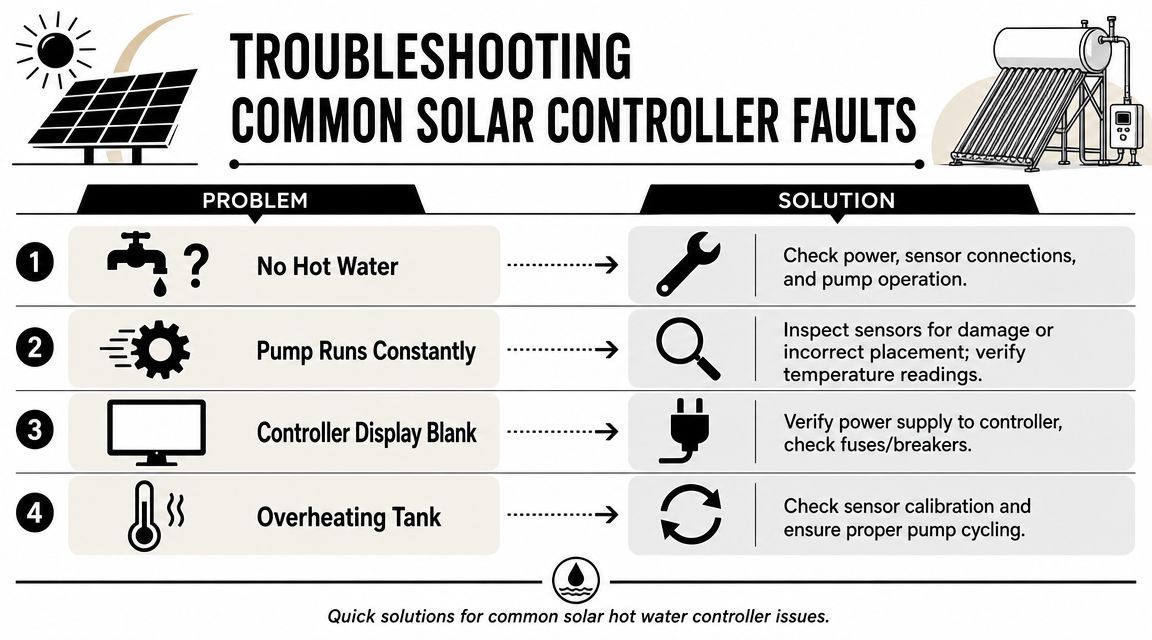
A solar hot water system usually tells you what's wrong by the symptom. The trick is not jumping straight to the controller as the culprit. Start with what the system is doing, then work backwards.
Pump runs at the wrong time
If the pump is running late in the day or after sunset, the usual suspects are:
- Sensor placement problems so the controller thinks the collector is still hotter than it really is
- Damaged or drifting sensors
- Incorrect differential settings
- Collector and tank sensors swapped at the terminals
Check the displayed temperatures first. If the numbers don't make physical sense, don't start replacing the pump.
Pump never starts
This one needs a calm sequence. Don't assume the controller is dead.
Try this checklist:
- Check controller power at the supply and any local isolation point.
- Look at the display for sensor fault or temperature error indications.
- Confirm the collector is hotter than the tank under sunny conditions.
- Test output switching if the controller has a manual or service mode.
- Prove the pump itself if the controller is calling for operation but nothing moves.
Sometimes the controller is fine and the pump has seized. Sometimes the pump is fine and the collector sensor has failed open-circuit.
No hot water or poor solar contribution
If the household is getting hot water mostly from boosting, the issue may be control-related, but it may also be broader system performance.
Common causes include:
- collector shading
- poor siting
- air in the loop
- failed or inaccurate sensors
- booster settings that cut in too aggressively
- control logic that short-cycles the pump and never builds tank temperature properly
For a broader fault list beyond the controller alone, Ring Hot Water has a useful guide to common problems with solar hot water.
Start with displayed temperatures, not assumptions. If the controller says the collector is cool at midday, you've either got a sensor issue or a heat collection issue.
Blank display or intermittent control faults
A blank screen often points to basic supply trouble. Check incoming power, fuses, breakers, and any external switching before condemning the unit.
Intermittent faults are trickier. Heat, moisture ingress, loose terminals, and aging sensors all create stop-start behaviour that looks like a software problem. If the system uses newer PV-direct hardware rather than a standard thermal controller, diagnosis needs extra care because controller, tank element, and electrical compliance all have to be considered together. That's one reason PV-direct needs a proper comparison before retrofit, not just enthusiasm for a newer idea.
If the fault involves mains wiring, relay damage, or uncertainty around booster control, call a licensed technician. Fault-finding is cheap compared with replacing the wrong parts.
Sourcing Solar Controllers and Spares in Melbourne
In Melbourne, the hard part often isn't finding a controller online. It's finding the right controller, the right sensor, and the right spare parts together so the repair sticks.
For local jobs, it helps to deal with people who understand the usual field issues. That includes failed PT1000 probes, mismatched sensors, tired pumps, damaged wiring tails, and control replacements where the original brand is no longer easy to source. If you're replacing a sensor, Ring Hot Water stocks a PT1000 solar hot water sensor that suits the kind of compatibility checks discussed earlier.
Melbourne owners also need practical support, not just boxes on a courier run. If you're in Sunshine, Yarraville, Footscray, or elsewhere across the metro area, local installation and repair backup matters because controller faults are often tied to the full system, not one isolated component. For trade buyers and regional customers, getting genuine spares shipped Australia-wide is just as important as getting a new controller.
If your solar hot water system isn't performing the way it should, or you need the right controller, sensor, or spare part without guesswork, contact Ring Hot Water. They supply genuine parts, support Melbourne installations and repairs, and can help you match components properly before you waste time on the wrong fix.

